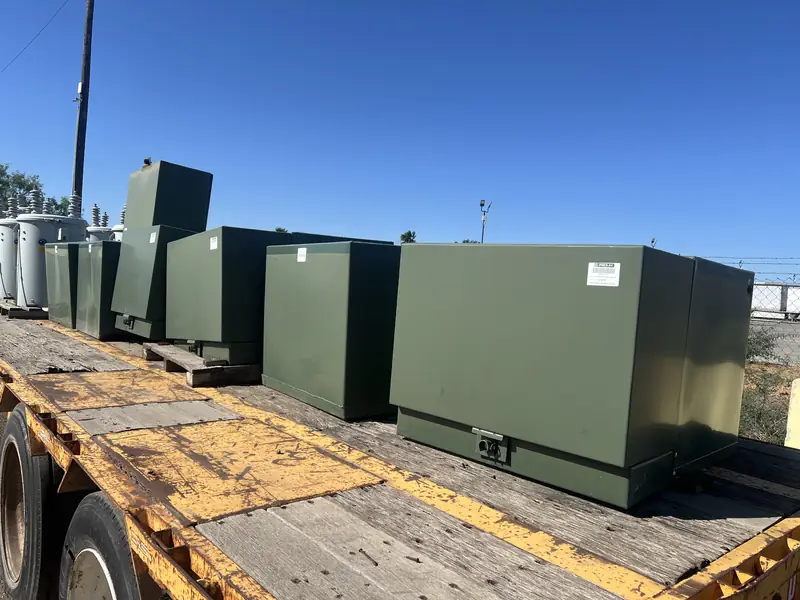
01What a Pad Mount Transformer Buyer Needs to Review
A pad mount transformer buyer needs more than an enclosure photo and a kVA rating. California Transformer Buyer reviews the electrical configuration, ownership, condition and practical removal requirements together. A unit that fits another project's voltage and cable arrangement may have a reuse opportunity; a similar-looking unit with different connections may not.
We review previously energized equipment, removed units, spare transformers, project leftovers and never-energized surplus. Single units and mixed lots are welcome for review, but purchase depends on the specific equipment. Start with the transformer selling checklist if your records cover several different transformer types.
- Confirm ownership or authority to sell, including utility release when applicable.
- Provide quantity, exact California location and current operating status.
- Identify missing accessories, known damage and available test reports.
- Describe site access and any removal obligations.
02Single-Phase and Three-Phase Pad-Mount Ratings
Single-phase pad-mounted distribution transformers commonly range from 10 to 167 kVA. Some are rated 250 kVA; larger special designs are manufacturer-specific. Residential units usually supply 120/240 V, with a center-tapped secondary and X1, X2 and X3 terminals. Our single-phase pad-mount identification guide explains the distinguishing features.
Three-phase units commonly serve commercial loads from 45 to 2500 kVA, while 3000, 3750, 5000 kVA and larger designs serve industrial and renewable projects. A 5000 kVA unit is 5 MVA, but size alone does not establish whether equipment is pad-mounted or station class. Cabinet construction and connection details matter.
For three-phase pad-mounted transformers, include the winding connection, impedance, BIL, taps, cooling class and temperature rise. Report every nameplate rating if fans provide additional cooling stages. Total weight and dimensions also help separate an electrical match from a unit that cannot fit the intended site.
| Configuration | Typical ratings | Common secondary | Important distinction |
|---|---|---|---|
| Single-phase distribution | 10–167 kVA; some 250 kVA | 120/240 V | Winding voltage versus system voltage |
| Three-phase commercial | 45–2500 kVA | 208Y/120 or 480Y/277 V | Delta/wye connection and impedance |
| Industrial or renewable | 3000–10000 kVA; custom larger | Project-specific | All ratings and application details |
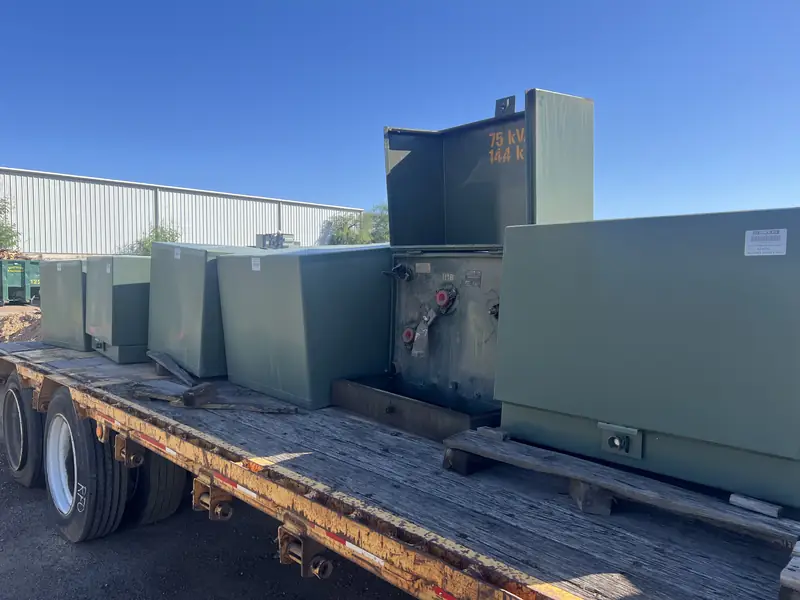
03California Primary Voltages: Read the Entire Nameplate
Relevant primary ratings include 12 kV, 12.47 kV, 16 kV, approximately 21 kV, 24.94 kV and 34.5 kV. These are not interchangeable, and a voltage-class description is not enough to confirm compatibility. Use the complete printed voltage, connection notation and tap range rather than guessing from the serving utility.
For example, 12,470GrdY/7,200 V identifies a grounded-wye system designation and a 7,200 V line-to-neutral winding rating. Likewise, 20,780GrdY/12,000 V is relevant to nominal 21 kV duties. Two primary bushings on a single-phase unit can indicate loop feed; they do not make it a two-phase transformer.
SCE documents 12 kV and 16 kV distribution, while PG&E and SMUD have 12 kV and nominal 21 kV duties. LADWP documents 34.5 kV applications. These examples provide context, not utility acceptance: the transformer voltage reference and your actual nameplate are the starting points.
Common secondaries are 120/240 V single-phase and 208Y/120 or 480Y/277 V three-phase. Delta secondaries also exist. Include the connection diagram because a matching voltage number alone does not establish a matching neutral or winding arrangement.
04Loop Feed, Radial Feed and Front Construction
Loop/radial and dead-front/live-front describe two independent attributes. A three-phase radial arrangement normally has three primary cable positions; a loop arrangement normally has six, or two per phase. Loop feed provides incoming and outgoing cable connections, but it does not guarantee a load-break switch or make the equipment a ring-main unit.
Dead-front construction uses shielded separable primary connectors. Live-front construction has exposed high-voltage bushing or terminal arrangements inside the cabinet. Dead-front does not mean safe to work on while energized, and not every dead-front connection is loadbreak-rated.
Report interface ratings and the installed protection arrangement. Bayonet fuses, current-limiting fuses and load-break switches can affect reuse compatibility; they are not interchangeable features. Provide accessory plates or existing records showing what is installed, including whether interfaces are 200 A loadbreak or 600 A deadbreak.
- Feed: loop or radial, with documented cable positions.
- Front: dead-front or live-front.
- Protection: bayonet and current-limiting fuse details, if fitted.
- Switching: switch type, rating and arrangement, if fitted.
- Connections: elbows, inserts, bushings and included accessories.
05Photos of the Nameplate, Compartments, Tank and Pad
Start with a readable, straight-on nameplate photograph and full exterior views from safe, authorized positions. Include all sides, the cabinet exterior, radiators, visible bushings and valves, accessory plates and the surrounding pad. Photograph corrosion, staining, dents or damaged parts rather than relying on a general condition description.
Views of both primary and secondary compartments help document connections, barriers and missing components, but do not open them yourself. Only qualified personnel may open electrical compartments after proper isolation, lockout, voltage verification and grounding as applicable. Existing authorized photos or documentation can support the initial review when interior access is unavailable.
Pad and access photographs should show ground-level clearances, gates, nearby structures and the route available for lifting equipment. Include dimensions, operating or shipping weight, identified lifting points and forklift or crane access. The removal and pickup planning guide covers the information needed to assign responsibilities.
- Nameplate: manufacturer, serial number, year and complete electrical ratings.
- Primary compartment: authorized views of interfaces, switches and fuses.
- Secondary compartment: authorized views of terminals, neutral and cable arrangement.
- Tank: radiators, visible leaks, corrosion and physical damage.
- Pad: clearances, surrounding obstacles and access route.
06Mineral Oil, FR3 and Condition Documentation
Pad-mounted transformers may contain mineral oil or natural ester fluid such as FR3. Report the actual fluid type and volume from the nameplate or records; enclosure color does not identify the liquid. Storage history, leaks, corrosion, repairs and the date last operated all affect the review.
Send available factory and service reports, including turns ratio, winding resistance, insulation and appropriate dielectric tests. Liquid dielectric results, PCB documentation and dissolved gas analysis can also be relevant. This is a records checklist, not a test procedure; testing and sampling belong with qualified personnel.
Under federal TSCA classifications, non-PCB means below 50 ppm, not zero PCBs. California has stricter rules for PCB-containing oil, including excluding oil containing 5 ppm or more PCBs from its used-oil category. The correct management pathway depends on testing and documentation, especially for leaking or failed equipment. Rely on qualified environmental professionals; this is not legal advice.
- Disclose overload, fault or flood exposure.
- Identify repairs, replacement parts and missing accessories.
- Provide fluid and PCB records without assuming labels settle every question.
- Describe indoor or outdoor storage and weather exposure.
07Solar Inverter Step-Up and New-Surplus Padmounts
Solar inverter step-up pad-mounts need an application-specific review. Send the low-voltage inverter-side rating, medium-voltage collection-side rating, connection diagram, impedance, taps and all cooling ratings. A project-specific transformer should not be described as an ordinary 480Y/277 V building-service unit unless its plate actually supports that description.
Include project specifications and factory reports when available, along with details of switches, fuses and monitoring accessories. For a pad mounted transformer for sale from a canceled project, state whether it was ever energized, how it was stored and whether packaging or accessories are missing.
Our new-surplus transformer review applies to never-energized units on skids or in crates as well as stored spares. Larger equipment with exposed station-class construction may instead fit the substation transformer buying page. A large MVA rating alone does not decide the category.
08Request a Written Offer From Rocky
To sell a pad mount transformer in California, call or text Rocky at (951) 403-5738, or use the transformer offer request form. Send the nameplate, overall photos, quantity, location and known condition. Reviewing your transformer costs nothing and there is no obligation.
Rocky reviews the information and may request ownership records, test reports, fluid documentation or access details. If an offer is made, it states the price, included equipment, loading and rigging responsibilities, freight arrangements and payment terms in writing before pickup.
Utility-owned equipment cannot be sold by a property owner merely because it sits on the property. Your qualified electrical contractor or serving utility handles isolation and disconnection, including potential solar, battery or generator backfeed. Removal and payment follow the agreed written terms rather than an assumed pickup arrangement.
FAQPad Mount Transformer Buyer FAQ
Can I request an offer while the transformer is still operating?
Yes. An initial review can begin with accessible nameplate information, safe exterior photographs and existing records. Clearly state that the unit is energized and describe when it may become available. Do not access compartments or alter the equipment for the review. Any isolation and disconnection must be handled by your qualified electrical contractor or serving utility.
Do used pad mounted transformers need recent test reports before I contact you?
You can contact Rocky even if recent reports are unavailable. Send what you have and distinguish factory tests from later service tests. Missing records may lead to follow-up questions and affect whether the unit can be evaluated for reuse. Do not arrange testing yourself without qualified personnel; the needed documentation depends on the transformer, its history and its condition.
Can you review a group of padmounts with different ratings?
Yes. California Transformer Buyer reviews mixed lots as well as individual units. Give each transformer a simple identifier and match its nameplate photo, condition notes and location to that identifier. List shared accessories separately. This avoids confusing one unit's voltage, phase or test report with another's and helps identify any equipment that requires a different review.
Does a green padmount cabinet prove that I own the transformer?
No. Cabinet appearance does not establish ownership, utility acceptance or even the exact equipment type. Check purchase records, asset records and any applicable utility documentation. If ownership is unclear, establish authority to sell before committing to a transaction. A transformer installed on private property may still belong to the serving utility.
Will an older transformer be rejected because of DOE efficiency rules?
Age alone does not answer whether a transformer has a reuse opportunity. DOE distribution transformer efficiency standards apply to manufacture; they do not automatically make existing used or surplus units illegal to resell. Suitability still depends on ratings, condition, documentation and the intended application. Supply the manufacturing year and factory records so the unit can be reviewed accurately.
Does being a padmount transformer buyer mean you buy leaking or failed units?
Not every condition results in a purchase. Disclose leaks, failure history, fault exposure and missing parts at the start, with safe photographs and available fluid records. Leaking or failed equipment can require environmental evaluation rather than an ordinary reuse transaction. Purchase terms and removal responsibilities depend on the review, and sellers should rely on qualified environmental professionals for the correct handling pathway.