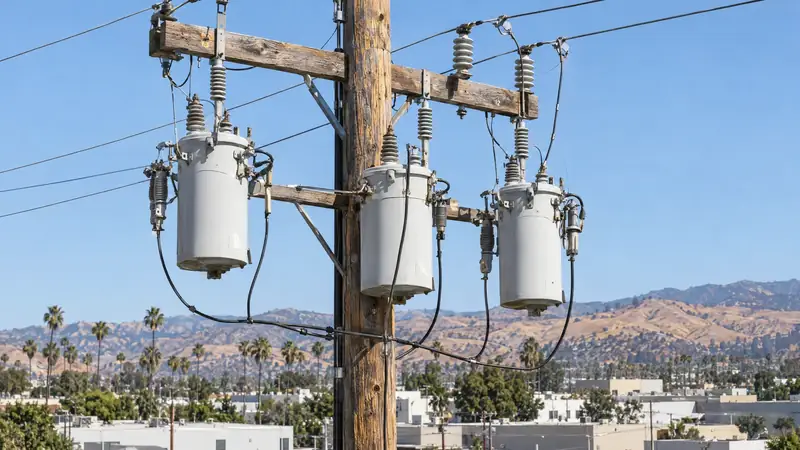
01What a Pole-Mount Transformer Looks Like
A pole-mount transformer is a liquid-filled distribution unit installed on an overhead utility pole. Most are single-phase, with a cylindrical tank, pole-hanger brackets, one or two high-voltage bushings, and low-voltage terminals with eyebolts or spades. A round tank alone does not confirm its rating or whether it is suitable for reuse.
Check the nameplate for manufacturer, serial number, year, kVA, phase, primary and secondary voltages, taps, impedance, cooling class, fluid type, and connection diagram. Polarity markings and CSP or CONV designations can help identify the unit’s configuration. Take photos from a safe position and only photograph equipment you are authorized to access.
- Record whether it is single-phase or three-phase.
- Note porcelain bushings, hangers, terminals, and visible damage.
- Photograph the nameplate and the full exterior.
02How a Pole Mount Transformer Buyer in California Reviews a Unit
California Transformer Buyer considers overhead distribution transformers from utility and privately owned systems throughout California. Pole-mounted units serve residential and rural distribution, small businesses, and overhead banks supplying three-phase service. They are also found on agricultural and oil-field properties; sellers in those sectors can learn more about our work with agriculture and water district equipment.
A transformer on private property is not necessarily privately owned. Confirm that you own the unit or have written authority to sell it before requesting an offer. Utility equipment cannot be sold by a property owner simply because it is mounted on their pole or located on their site; see the utility ownership checklist if ownership is unclear.
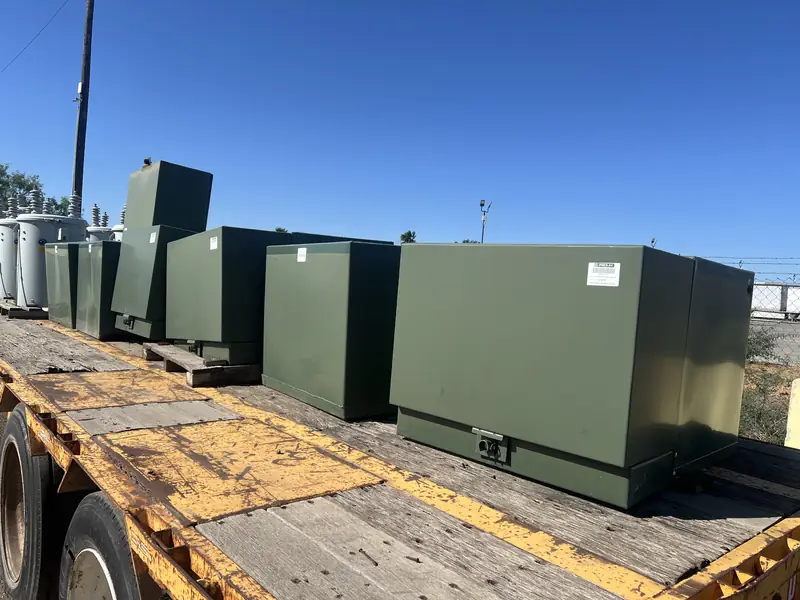
kVACommon Pole-Mount Sizes We Buy
03Pole-Mount Transformer Sizes, Voltages, and Service
Common single-phase pole-mount transformer sizes run from 5 to 167 kVA. Conventional and surge-protected designs are also available at 250, 333, and 500 kVA, while dedicated three-phase overhead transformers have their own rating ranges. Three single-phase units may be banked to provide three-phase service; list each can separately and say whether the units form a matched bank.
Primary winding ratings are commonly about 2.4–19.92 kV. Grounded-wye systems can reach 34.5 kV. Secondary ratings often include 120/240 V or 240/480 V, with 277 V and other utility configurations also used. California systems vary, so the actual nameplate—not a general utility voltage assumption—determines whether a unit matches an intended application.
| Nameplate kVA | Seller should clarify |
|---|---|
| 5–15 kVA | Exact rating and secondary |
| 25–75 kVA | Voltage, phase, and condition |
| 100–167 kVA | Taps, connection, and accessories |
| 250–500 kVA | Conventional or surge-protected design |
04Conventional and CSP Pole-Top Designs
A conventional overhead transformer generally relies on external utility protection, such as fuses or cutouts and arresters. Do not call a conventional unit CSP just because an arrester has been attached. If it has an internal fuse option, disclose that separately and photograph the equipment as it is.
A CSP, or completely self-protected, transformer has an integrated protection package that typically includes high-voltage internal fuse links, a low-voltage circuit breaker, and surge arresters. Exact packages vary by manufacturer and model. The breaker handle, arrester arrangement, CSP marking, and nameplate help distinguish the configuration; do not operate or reset components for a sale inspection.
- Conventional: external protective equipment is typical.
- CSP: integrated protection components are typical.
- Both designs are usually liquid-filled and self-cooled.
05What Affects the Resale Value of a Used Pole-Mount Transformer
A buyer’s assessment depends on the actual nameplate and the unit’s condition, not appearance or kVA alone. Voltage, phase, taps, connection, polarity, age, and whether the unit is conventional or CSP all affect potential reuse. Common ratings and configurations may suit more applications, but no particular rating guarantees a sale.
Condition matters, including leaks, rust, damaged porcelain, worn hangers, missing parts, or signs of prior failure. Fluid type and quantity, PCB documentation, winding material when known, and test records can also inform the review. A complete matched bank may be more useful than unrelated cans, so identify the relationship and list ratings separately. Our 100 kVA transformer details offer a useful example of why exact nameplate information matters.
- Whether the unit is used or new-surplus
- Nameplate details and compatible voltage
- Condition of bushings, tank, and accessories
- PCB records and available test reports
- Quantity, location, access, and bank completeness
06What to Send for an Offer
To start a review, send clear nameplate and overall photos, the number of units, their California location, and known condition. Include whether the equipment is still installed, removed, or new-surplus, and whether you believe it is part of a complete bank. Do not access equipment unless authorized, and do not open compartments to get additional information.
If available, include test reports, fluid or PCB records, ownership information, and details about site access. Rocky may ask follow-up questions to verify specifications and logistics. You can use the transformer submission process or text photos to (951) 403-5738.
- Nameplate and full-unit photos
- Quantity, location, and known condition
- Ownership or authority to sell
- Test, fluid, and PCB documentation
- Whether units form a matched bank
07Removal, Electrical Safety, and Environmental Records
Do not de-energize, disconnect, lower, move, open, or drain a pole-mounted transformer yourself. The owner’s qualified electrical contractor or serving utility handles isolation and disconnection, including consideration of possible backfeed from solar, batteries, or generators. Take photographs only from a safe position.
Before pickup, the written offer states what is included, who handles rigging and freight, and the payment terms and timing. Removal is scheduled under those written terms. A pole transformer is not automatically interchangeable with a pad-mounted unit; the mounting, connections, protection, and application differ. For removal planning, see transformer removal and pickup considerations.
Rely on testing, records, and qualified environmental professionals to establish fluid and PCB status. Unknown documentation is not proof that oil is PCB-free, and California requirements for PCB-containing oil depend on the test results and applicable pathway. This information is general and is not legal advice.
08Why Sellers Contact California Transformer Buyer
Rocky reviews used, pulled, surplus, new-surplus, spare, and project-leftover transformers from sellers located in California. A seller can start with one pole unit or provide details on a larger lot. Reviewing a transformer costs nothing and creates no obligation.
Send photos and the basic unit information by text to (951) 403-5738 or contact California Transformer Buyer through the request an offer form. The written offer sets out the proposed purchase and pickup terms before removal is arranged.
FAQPole-Mount Transformer FAQ
Can I sell a pole transformer that is still on a utility pole?
Possibly, but first establish who owns it and who has authority to sell it. A utility may own equipment located on private property, and the property owner cannot sell utility-owned equipment. Do not disconnect or lower an installed unit. The serving utility or the owner’s qualified electrical contractor must handle electrical isolation and removal arrangements.
Do you buy a single used pole-mount transformer, or only full banks?
California Transformer Buyer reviews individual units as well as complete banks and mixed lots from California sellers. For a single unit, send its nameplate and overall photos. If you have multiple cans, list each kVA rating and voltage and explain whether they were used together as a matched bank. The offer depends on the specifications, condition, and practical pickup details.
Can I sell a CSP transformer if its breaker is damaged?
You can submit it for review, but disclose the breaker issue and provide photos of the nameplate and exterior components from a safe position. CSP breaker condition and replacement-component availability can affect its potential reuse. Do not operate or reset the breaker to test it. Share any existing inspection or test documentation instead.
Is a pole-mounted transformer suitable for a pad-mounted installation?
Not automatically. Pole-mounted and pad-mounted equipment have different physical configurations, connections, protection, and installation requirements. A unit should not be represented as suitable for a pad application based only on kVA or voltage. Have a qualified electrical professional determine application suitability from the design and nameplate information.
What if I do not know the transformer’s PCB status?
Tell us that the status is unknown and share any available labels, records, or test results. Do not assume the oil is PCB-free based only on appearance or age. Testing, documentation, and qualified environmental professionals are the basis for determining status and appropriate handling. California’s rules for PCB-containing oil are specific, so obtain advice for the actual equipment and records.
What happens after I send photos and nameplate information?
Rocky reviews the information and may ask about test reports, fluid or PCB records, ownership, and site access. If the unit is a fit, you receive a written offer that states the price, what is included, who handles rigging and freight, and payment terms and timing. Pickup is scheduled and handled under those terms; there is no obligation to proceed with a review.