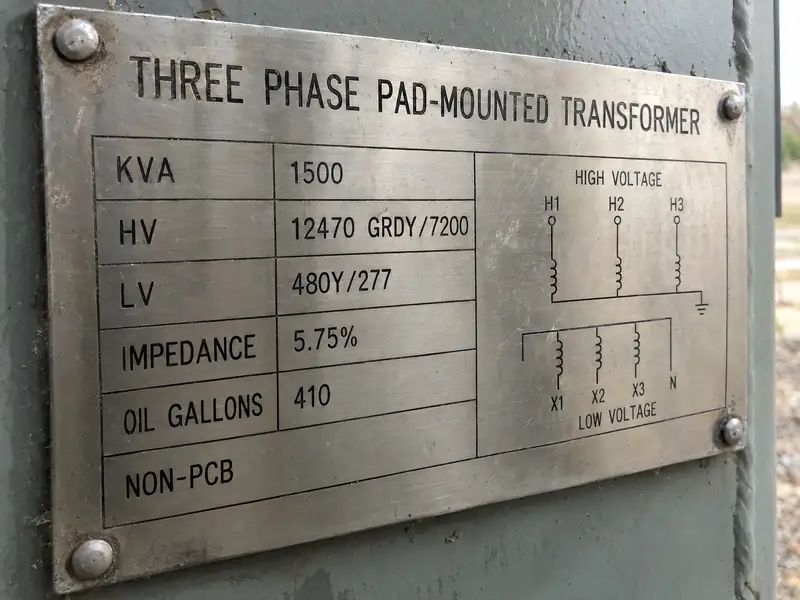
01Reading Transformer Voltage Ratings Without Guessing
Transformer voltage ratings describe electrical compatibility, not capacity. A 1000 kVA transformer and a 2500 kVA transformer can have identical primary and secondary voltages but different current capabilities, dimensions and applications.
Start with the HV and LV fields, then check phase, frequency and the connection diagram. HV means high voltage; LV means low voltage. For a step-up application, the input can be the LV winding, so primary does not always mean high voltage. Compare capacity separately using the transformer kVA and MVA size guide.
DIRVoltage Classes We Buy
- 120/240 V TransformersLearn how to identify, assess and sell a used or surplus 120/240 V transformer in California.
- 208Y/120 V TransformersIdentify, assess and sell eligible 208Y/120 V transformers from California commercial properties.
- 480Y/277 V TransformersLearn how to identify, evaluate and sell a used or surplus 480Y/277 V transformer in California.
- 4160 V (4.16 kV) TransformersLearn how to identify, assess and offer a used or surplus 4160 V transformer in California.
- 12 kV & 12.47 kV TransformersLearn how to identify, evaluate and offer 12 kV and 12.47 kV transformers for sale in California.
- 21 kV Class TransformersLearn how to identify, assess, and offer a 21 kV Class transformer for sale in California.
- 34.5 kV TransformersLearn how to identify, evaluate and sell a 34.5 kV transformer in California.
- 66 kV, 69 kV & 115 kV TransformersLearn how 66 kV, 69 kV and 115 kV transformer nameplates, ratings and reuse needs affect a California sale.
02Primary and Secondary Voltage: Line-to-Line Versus Line-to-Neutral
On a three-phase wye system, line-to-line voltage is approximately 1.732 times line-to-neutral voltage. A 480Y/277 transformer therefore supplies approximately 480 volts between phases and 277 volts between a phase and neutral. The two numbers do not represent selectable output voltages.
Similarly, a 208Y/120 transformer supplies 208 volts phase-to-phase and 120 volts phase-to-neutral. Single-phase 120/240 V uses a different arrangement: a center-tapped secondary provides 120 volts from either end to neutral and 240 volts end-to-end.
| Nameplate rating | System | Voltage interpretation |
|---|---|---|
| 120/240 V | Single-phase, center-tapped | 240 V end-to-end; 120 V to neutral |
| 208Y/120 V | Three-phase wye | 208 V line-to-line; 120 V line-to-neutral |
| 480Y/277 V | Three-phase wye | 480 V line-to-line; 277 V line-to-neutral |
| 240 V delta high-leg | Three-phase, center-tapped delta | 240 V line-to-line; neutral voltages vary |
03Wye, Delta and the Meaning of GrdY
Wye connects three windings at a common point; delta connects them in a closed loop. A wye connection can provide a neutral when that point is brought out. Delta does not inherently provide a neutral, although a center-tapped delta winding can.
GrdY means grounded wye. The notation 12,470GrdY/7,200 V identifies a grounded-wye system with approximately 12,470 volts line-to-line and 7,200 volts line-to-neutral. On single-phase equipment, that notation can indicate suitability for phase-to-neutral connection on that system; read the winding diagram to confirm.
Do not treat delta and grounded-wye equipment as interchangeable based on voltage alone. Neutral requirements, grounding, phase displacement and protection must be checked by the project’s electrical engineer or qualified contractor.
04California Primary Voltages Are Not One Statewide Standard
California distribution voltages vary by utility and circuit. PG&E documents 12 kV and nominal 21 kV distribution; SCE uses 4 kV, 12 kV and 16 kV, with 25 kV and 33 kV also documented. SDG&E uses 12 kV distribution, while SMUD uses 12 kV and 21 kV.
LADWP documents 4.8 kV and 34.5 kV, plus 2.4 kV and 4.16 kV primary-metered service. Private industrial systems may also use 4160 V transformers. These examples do not establish the voltage available at a particular address.
A listing described as a “12470 transformer” needs clarification. Review the distinction between 12,000 V and 12,470 V transformer ratings, and use the exact connection shown on the nameplate. Likewise, 21 kV class equipment may carry a rating such as 20,780GrdY/12,000 V rather than exactly 21,000 V.
05Choose the Secondary Rating That Matches the Load
Voltage compatibility extends beyond the primary supply. A facility designed around 480Y/277 V transformers cannot substitute a 208Y/120 V secondary without redesigning affected distribution and loads. Motors, lighting, panelboards and protective devices have their own voltage requirements.
Commercial loads using 208Y/120 V transformers differ from single-phase services supplied by 120/240 V transformers. Also distinguish 240 V high-leg delta from 208Y/120 V: the high leg is approximately 208 volts to neutral and is not a 120 V branch-circuit source.
06Voltage Taps Adjust the Ratio Within Defined Limits
Taps change the effective winding turns ratio to accommodate specified supply variations. A nameplate may list several primary tap voltages or percentage steps around a nominal rating. Record the complete tap schedule rather than assuming every transformer has the same adjustment range.
Taps do not make unrelated voltage systems interchangeable. A de-energized tap changer and a load tap changer also have different operating requirements. Sellers should provide existing records; any verification or adjustment belongs to qualified personnel under the equipment’s operating instructions.
07BIL Is an Insulation Rating, Not Operating Voltage
Basic impulse insulation level, or BIL, describes insulation withstand capability for a standardized impulse test. It is usually expressed in kilovolts and is separate from normal operating voltage. A BIL value is not permission to operate the winding continuously at that voltage.
Buyers also check impedance, cooling class, temperature rise and configuration. A pad-mounted distribution unit and a station-class substation transformer can serve similar voltage functions while having very different installation requirements. The transformer type guide explains those equipment families.
08Send the Complete Nameplate for a California Offer
California Transformer Buyer reviews used, surplus and new-surplus equipment from California sellers. Text Rocky at (951) 403-5738 or request a transformer offer with safely obtained nameplate and overall photos, quantity, location and condition.
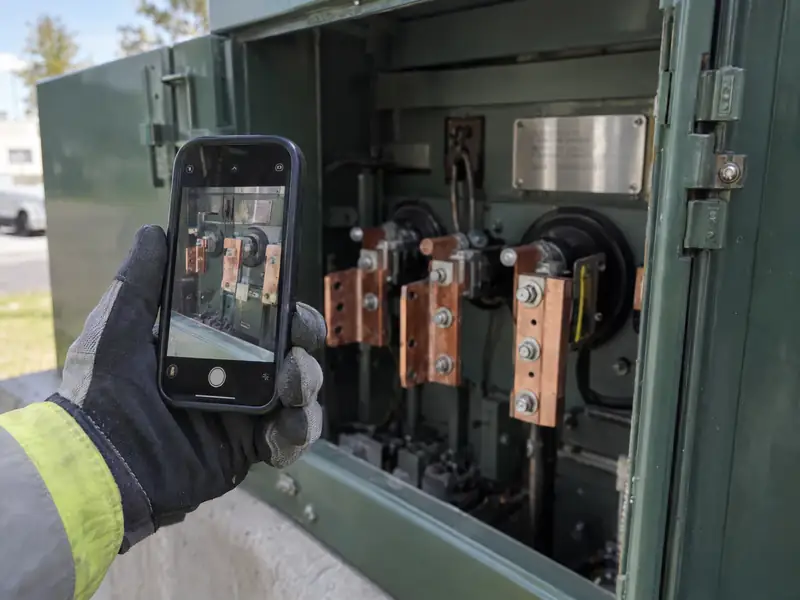
Include HV/LV connections, taps, kVA or MVA, phase, BIL and available test reports. Photograph only equipment you are authorized to access, from a safe position; do not open compartments. Qualified contractors or the serving utility handle isolation and disconnection. Any offer states the terms, including rigging, freight and payment responsibilities, in writing.
FAQVoltages FAQ
Can a 12,470 V transformer replace a 12,000 V transformer?
Not automatically. The nominal voltages differ, and the units may also have different winding connections, grounding requirements or tap ranges. An engineer must compare the actual supply, complete nameplates and intended load voltage. A tap schedule may accommodate a particular application, but the rounded description “12 kV class” is not enough to establish compatibility.
Does a 480 V nameplate mean the transformer provides 277 V?
No. A 480Y/277 V wye secondary with an accessible neutral can provide 277 V phase-to-neutral. A 480 V delta secondary does not inherently provide that neutral or voltage. If the plate says only 480 V, the connection diagram and terminal information are needed before describing it as suitable for 277 V loads.
Should I report the current tap position or every available tap?
Provide both if they are already documented. The full tap schedule describes the transformer’s designed adjustment options, while the recorded position helps explain its previous application. Do not operate a tap changer or open equipment to obtain this information. If the position is unknown, say so and send the readable nameplate.
Can I identify transformer voltage from the enclosure or bushings?
Appearance can suggest an equipment family, but it cannot reliably establish the exact voltage ratio or connection. Similar padmount enclosures may contain different primary and secondary ratings. Use the nameplate, serial-number documentation and existing test reports. If the plate is missing, provide available records rather than assigning a rating by appearance.
Does a common California voltage guarantee a purchase offer?
No. Common configurations may be easier to match with a reuse application, but voltage is only one factor. Capacity, condition, test records, fluid documentation, accessories and removal requirements also matter. California Transformer Buyer reviews the specific unit; reviewing your transformer costs nothing and carries no obligation.
Can I sell a utility transformer located on my property?
Only if you own it or have authority from its owner to sell it. Location on your property does not establish ownership, even if it serves your building exclusively. Check ownership records before requesting an offer. Do not access utility equipment or attempt disconnection; the serving utility controls its equipment and associated work.