01How to Identify a Unit Substation Transformer
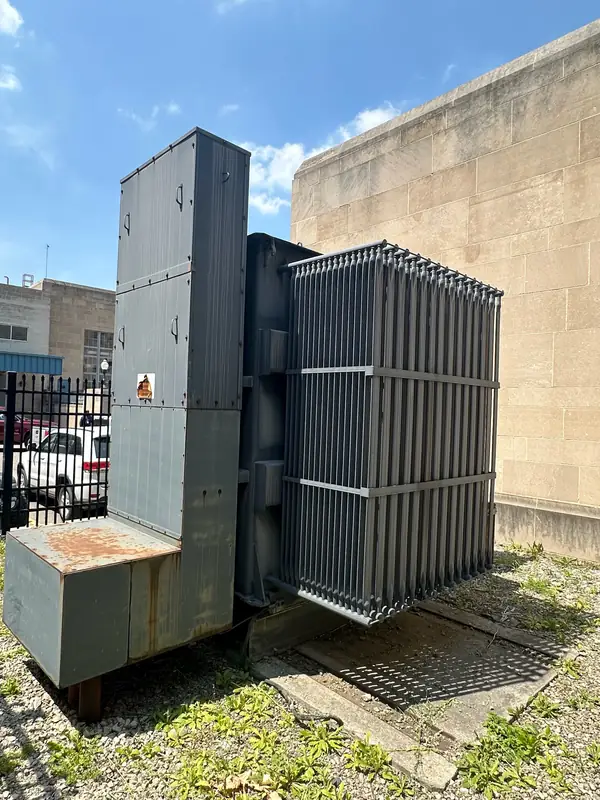
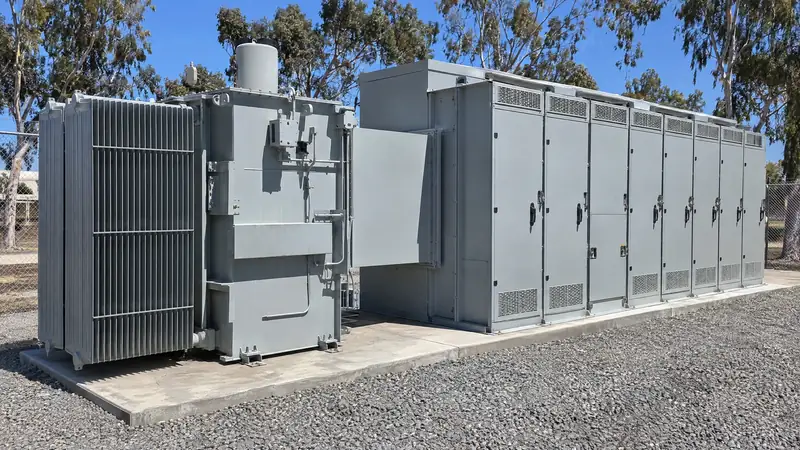
A unit substation is an assembly, not simply a stand-alone transformer. The transformer section is close-coupled to switching and protection equipment, often through a throat, flange or bus connection. A secondary unit substation takes medium-voltage input and supplies low-voltage switchgear or a switchboard; a primary unit substation transforms between medium-voltage systems.
Look from a safe position for adjacent switchgear, a primary switch section, a bus throat or flanged connection, and nameplates on both the transformer and the larger assembly. Side-mounted bushings or a terminal chamber may connect the transformer to the switchgear. A loose transformer removed from the assembly may still be usable, but it is no longer a complete unit substation.
The word “primary” in primary unit substation describes the assembly category. It does not mean the transformer has a separate primary winding beyond the normal high- and low-voltage windings. See the broader [transformer types guide](transformer types and configurations) for related equipment.
- Record the transformer and assembly nameplates separately.
- Photograph the throat, flange and bus connection from a safe position.
- Note whether the switchgear is included or has already been removed.
02How Unit Substations Serve California Facilities
A secondary unit substation receives medium-voltage power and steps it down near the facility load, reducing the need to distribute large low-voltage currents over long distances. Its secondary commonly feeds a switchboard or low-voltage switchgear. A primary unit substation instead provides medium-voltage transformation and distribution within a larger electrical system.
These assemblies are used at factories, hospitals, campuses, data centers and large commercial properties where substantial loads need organized distribution and local switching. Industrial facilities may have several transformers serving separate buildings or process areas. For manufacturing applications, see our page on [transformers for industrial plants](manufacturing and industrial plant transformers).
California service voltages vary by utility and site. The actual nameplate is the reliable source: a unit’s primary may be in the 2.4–34.5 kV range for a secondary substation, while common low-voltage outputs include 208Y/120 V, 480Y/277 V, 480 delta or 600 V. Utility service configurations differ across the state, so do not infer a transformer’s voltage from its location alone.
kVACommon Unit Substation Sizes We Buy
03Unit Substation Transformer Sizes and Voltages
Secondary unit-substation transformers commonly range from about 112.5 to 3,750 kVA, with 225–3,750 kVA a useful range for many facility units. Larger custom secondary units also appear in manufacturer portfolios. Primary unit-substation transformers may range from 500 kVA to 20 MVA, depending on system needs and configuration.
| Category | Typical rating | Typical voltage arrangement | Common applications |
|---|---|---|---|
| Secondary unit substation | 112.5–3,750 kVA common | 2.4–34.5 kV to low voltage | Factories, hospitals, campuses |
| Large custom secondary | 5,000–10,000 kVA | Medium voltage to low voltage | Large facility loads |
| Primary unit substation | 500–20,000 kVA | 6.9–69 kV to 2.4–34.5 kV | Large load centers |
Read More Than the kVA Rating
A buyer also needs the primary and secondary voltages, phase, frequency, connection, taps, impedance, BIL and cooling class. On liquid-filled equipment, record the fluid type and gallons; on dry-type equipment, note the insulation construction and temperature rise. Multi-stage ratings and cooling designations, such as ONAN/ONAF, should be captured exactly as shown.
A [2,000 kVA transformer](2,000 kVA transformer rating example) and a [3,750 kVA transformer](3,750 kVA transformer rating example) can differ substantially in bus, footprint and site requirements even when both are unit-substation equipment.
04Liquid-Filled, Dry-Type and Close-Coupled Variations
Unit substation transformers may be liquid-filled with mineral oil, natural ester or silicone, or dry-type with VPI, VPE or cast-coil construction. Liquid-filled designs commonly have a tank, bushings, gauges and sometimes radiators or fans. Dry-type units are installed where that construction suits the facility and its electrical room or equipment arrangement.
The physical connection matters as much as the transformer rating. Throat orientation, flange dimensions, bus arrangement, phase sequence and footprint affect whether a transformer can match existing switchgear. If you have a [liquid-filled transformer](liquid-filled transformer) or a [dry-type transformer](dry-type transformer), include clear photos of its construction and connections.
05What Affects Resale Value and Reuse Potential
There is no single resale figure for every unit substation transformer. Rating, voltage configuration, condition, age, insulation type and the availability of credible test records all affect whether a unit fits another project. Common, documented voltage configurations may be easier to place than unusual designs, but suitability depends on the prospective installation.
The transformer-to-switchgear match can materially affect usefulness. Exact impedance, secondary current or bus rating, throat orientation, footprint and mating-flange drawings help establish compatibility. Accessories, missing parts, winding material, leaks, rust, damaged bushings and the presence of included switchgear also matter. Quote the transformer and switchgear sections individually if they are being sold together.
New-surplus equipment that has never been energized is different from used or pulled equipment, so state its status accurately. Provide factory test reports, oil test or DGA records, insulation-resistance or turns-ratio results if available. For liquid-filled units, share PCB labels, test results and records; sellers should rely on testing, documentation and qualified environmental professionals to determine environmental status. This information is not legal advice.
06What to Send a Unit Substation Transformer Buyer
California Transformer Buyer reviews equipment from sellers located in California. To start, text photos to Rocky at (951) 403-5738 or use the [transformer offer request page](sell a transformer and request an offer). Reviewing your transformer costs nothing and creates no obligation.
Send nameplate photos, overall views of the transformer and assembly, quantity, California location and a brief condition description. Take photos only from a safe position and only where you are authorized to access the equipment. Rocky may ask for ownership or sale authority, site access details, test reports, fluid or PCB records, and information about whether switchgear is included.
- Transformer and assembly nameplates
- Primary and secondary voltage, kVA and phase
- Throat, flange, bus and footprint details
- Condition, missing parts and included sections
- Available test, fluid and PCB documentation
- Location, access limits and quantity
07Plan Removal with Qualified Electrical and Rigging Teams
A unit substation can be heavy and interconnected with building electrical systems. De-energizing, isolation, testing for voltage, grounding and disconnection must be handled by the owner’s qualified electrical contractor or the serving utility—not by the seller. Backfeed from solar, batteries or generators must also be considered.
Before pickup, the written offer will state what is included, who handles loading or rigging, freight arrangements and payment terms and timing. Removal is scheduled after the terms are agreed. Large equipment may require specialized transport and permits, and site access, lifting points, clearances and local road conditions can affect planning. See [transformer removal and pickup details](transformer removal and pickup planning).
08Sell Used or Surplus Unit Substation Equipment in California
Rocky buys used, pulled, surplus, new-surplus and decommissioned transformers from sellers throughout California, from single units to larger lots. Sellers bring unit substations because the transformer may have value apart from an upgrade or facility closure, and a complete assembly may include switchgear that should be evaluated separately.
Call or text (951) 403-5738 with the nameplate and photos, or submit the website form. California Transformer Buyer will review the details and provide a written offer when the unit is a fit. You must own the equipment or have authority to sell it; utility-owned equipment located on private property cannot be sold by the property owner.
FAQUnit Substation Transformer FAQ
Can I sell only the transformer section if the switchgear stays?
Yes, the transformer section can be reviewed separately, but identify clearly what is and is not included. A loose transformer may be reusable, yet it is not a complete unit substation. Share photos of the connection side, throat or flange, bus dimensions if documented, voltage and impedance. A buyer needs those details to assess whether the transformer can match another assembly.
What photos should I take if the equipment is still installed?
From a safe position and only where you are authorized, photograph the transformer overall, its nameplate, the assembly nameplate, adjacent switchgear, visible throat or flange, and any accessible condition issues. Do not open compartments or approach energized components to get a better image. If you cannot safely read a plate, provide the information you can and explain what is unavailable.
Does a unit substation have to be operational to be considered?
Not necessarily. California Transformer Buyer reviews used, pulled, surplus, new-surplus and decommissioned equipment, but condition and documentation affect whether a particular unit is suitable. Disclose known faults, leaks, damaged bushings, missing parts and available test results. A review is not a guarantee of purchase, and failed or leaking equipment may need additional environmental and handling determinations.
What if I do not know the transformer’s exact kVA or voltage?
Start with clear photos of every visible nameplate and share the manufacturer, serial number or other identifying details you can read. The nameplate is the best source for kVA, primary and secondary voltage, taps, connection and impedance. Do not guess based on the building or utility service. If a plate is unreadable or missing, tell Rocky what information is uncertain.
Can you buy the transformer and switchgear as one package?
Send details for both sections, including separate nameplates, overall photos and whether the sections remain connected. The transformer and switchgear are reviewed as distinct components because their condition, configuration and reuse potential may differ. Any written offer will specify exactly which equipment is included, along with loading, rigging, freight and payment terms before pickup.
Can a property owner sell a utility-owned unit substation?
Only the owner, or someone authorized by the owner, can sell the equipment. A transformer being located on private property does not by itself establish that the property owner owns it; utility equipment may remain utility-owned. Confirm ownership or obtain sale authority before requesting an offer. If ownership is unclear, resolve that question with the responsible utility or equipment owner.