01Padmount vs Polemount vs Substation: The Practical Differences
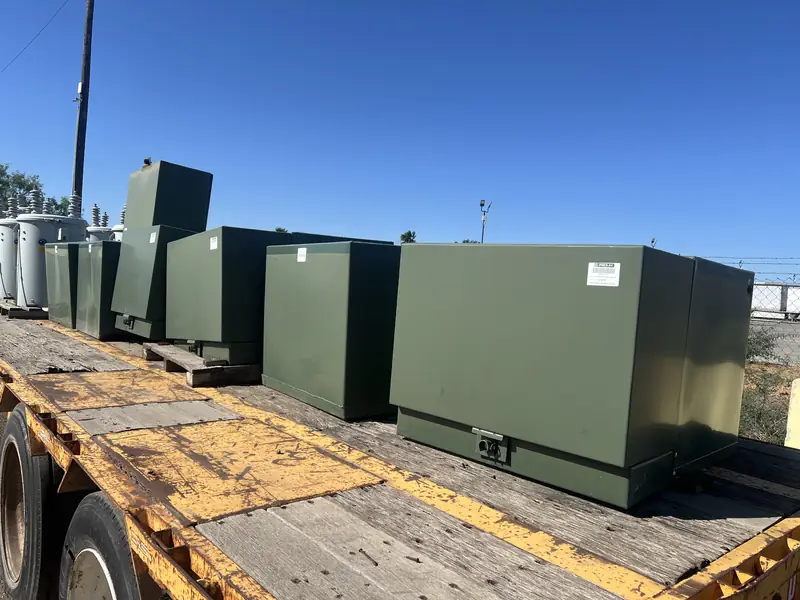
For a seller, the first useful distinction is how the transformer was installed and connected. A pad mount typically has a ground-level enclosure with cable compartments. A polemount typically has a tank and bushings arranged for overhead service. Substation equipment can have exposed terminals within a controlled-access yard or enclosed connections to adjacent switchgear.
These categories are not rigid capacity bands. A large three-phase pad-mounted transformer can overlap a smaller substation transformer in kVA, while a unit substation may use a liquid-filled or dry-type transformer. The construction label helps identify the equipment; it does not establish compatibility or resale value by itself.
If the installation is unfamiliar, start with the nameplate and exterior photographs rather than guessing. Our guide to transformer types covers additional families, including vault, network, dry-type, and specialty equipment.
| Feature | Pad-mounted | Pole-mounted | Substation |
|---|---|---|---|
| Placement | Ground-level pad | Utility pole or overhead structure | Station yard or unit-substation assembly |
| Connections | Enclosed cable compartments | Bushings for overhead connections | Yard terminals or switchgear interfaces |
| Common service | Underground distribution | Overhead distribution | System transformation or facility distribution |
| Phase | Single-phase or three-phase | Often single-phase; banks serve three-phase | Often three-phase; single-phase units also exist |
| Key resale checks | Voltage, feed arrangement, accessories | Individual ratings and bank configuration | All cooling ratings, interfaces, transport needs |
02Pad-Mounted Transformers: Cabinets, Cable Interfaces, and Feed Arrangements
A pad-mounted transformer generally combines the transformer tank with an enclosure that protects the primary and secondary connections. Underground cables enter the connection area, making this construction common at commercial properties, residential developments, and industrial facilities. Single-phase and three-phase versions serve different loads.
For resale, identify whether the primary arrangement is radial-feed or loop-feed and whether the interfaces are dead-front or live-front. Loop-feed equipment can provide incoming and outgoing primary cable connections; radial-feed equipment generally serves a terminating feed. These details affect whether a prospective installation can use the unit without major changes.
Standard single-phase pad-mount scope reaches 250 kVA, while three-phase scope reaches 10 MVA. Those limits do not mean every size or configuration has equal demand. A 1000 kVA unit with 480Y/277 V secondary service is a different application from one with 208Y/120 V, even when the cabinets look similar.
For this family, the pad-mount transformer buying page explains the seller information needed for review. Record installed accessories from existing records or safely visible labels; do not open compartments to identify them.
- Single-phase or three-phase rating
- Actual primary and secondary voltages
- Radial-feed or loop-feed arrangement
- Dead-front or live-front construction
- Documented fuses, switches, elbows, and gauges
03Pole-Mounted Transformers: Individual Units Versus Three-Phase Banks
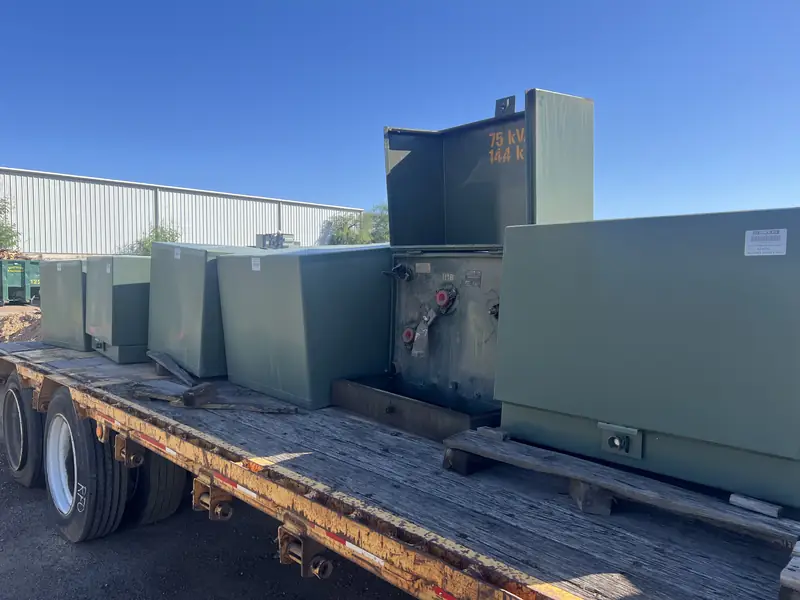
Pole-mounted distribution transformers are commonly single-phase, liquid-filled units serving overhead circuits. Conventional units rely on external protection arrangements, while completely self-protected, or CSP, designs incorporate protection features. The precise equipment configuration still needs verification.
Common single-phase ratings include 10, 15, 25, 37.5, 50, 75, and 100 kVA, with larger ratings also available. A 120/240 V secondary is common for single-phase service. However, neither a cylindrical tank nor its apparent size establishes its voltage or capacity.
Three single-phase transformers can form a three-phase bank, but buyers need each unit's nameplate—not just a claimed total bank rating. Connections, matching characteristics, and individual condition matter. Some three-phase arrangements use two transformers, so quantity alone is not enough to identify the electrical configuration.
Utility ownership is especially important with pole-mounted equipment. A transformer located above your property does not necessarily belong to you. Confirm title or written authority before offering it for sale, and leave access and electrical work to the serving utility or qualified contractor.
04Substation Transformers: Cooling Stages, Tap Changers, and Switchgear Interfaces
“Substation transformer” covers more than one construction. Station-class power transformers commonly serve higher-capacity systems and may include radiators, fans, tap changers, and substantial bushings. Unit substations combine a transformer with closely connected primary or secondary equipment for facility distribution.
Power and station-class equipment often falls above roughly 2.5–10 MVA, but that is a broad family description, not a universal cutoff. Smaller transformers can be installed in substations, and large pad-mounted units can overlap those ratings. Remember that 1000 kVA equals 1 MVA.
Capture every nameplate capacity stage. A rating such as 12/16/20 MVA ONAN/ONAF/ONAF identifies different capacities under specified cooling conditions; reporting only 20 MVA omits important operating requirements. Also identify any load tap changer, or LTC, versus a de-energized tap changer, or DETC.
For a unit substation, connection orientation and the interface to switchgear can be as important as voltage. Include drawings when available, along with an inventory of associated equipment. The substation transformer buying page addresses this larger-equipment review.
- All kVA or MVA cooling-stage ratings
- ONAN, ONAF, or other stated cooling class
- Tap changer type and documented condition
- Radiators, fans, bushings, and controls included
- Dimensions, weight, and switchgear interfaces
05California Voltage Compatibility Matters More Than Cabinet Size
A used transformer is useful only when its electrical characteristics fit the intended system. Primary voltage, secondary voltage, phase, delta or wye connection, grounding arrangement, impedance, and basic impulse insulation level all matter. Two transformers with the same kVA may not be interchangeable.
California distribution systems vary. SCE has documented 4 kV, 12 kV, and 16 kV distribution systems; PG&E has 12 kV and nominal 21 kV distribution; SMUD also uses 12 kV and 21 kV. Those regional examples are context, not permission to substitute one nameplate voltage for another.
For example, 12,000 V delta and 12,470GrdY/7,200 V are not identical specifications. Likewise, 208Y/120 V and 480Y/277 V secondaries serve different requirements. Use the full nameplate notation and connection diagram rather than describing a unit only as “12 kV.”
The transformer voltage reference provides additional California context. Final suitability requires engineering review and, where applicable, the serving utility's requirements; California Transformer Buyer is not affiliated with any utility.
06What Changes Resale Prospects Within Each Transformer Family
Construction affects the potential application, but condition and documentation distinguish otherwise similar units. Buyers consider age, winding material when documented, temperature rise, fluid type, accessories, leaks, corrosion, damaged bushings, and missing components. A complete unit with clear records is easier to evaluate than one with an unreadable plate and an uncertain history.
Never-energized equipment and previously energized equipment should be described separately. Storage conditions still matter for new-surplus units: unused does not establish that seals, insulation, or accessories remain in satisfactory condition. Factory reports and maintenance records help explain the equipment's history without overstating it.
For liquid-filled equipment, existing oil tests and dissolved gas analysis can help assess condition, but they do not replace all electrical testing or establish PCB status unless the records include that analysis. See transformer oil testing and resale considerations for the role of these reports.
Fluid type is a separate question from installation style. Mineral oil, natural ester, and other insulating fluids require accurate identification. Our dry-type versus oil-filled comparison explains insulation differences that can also apply within unit substations.
07Ownership, PCB Records, and Removal Requirements Before a Sale
Confirm that you own the equipment or have authority to sell it. Electrical isolation, disconnection, and any compartment access belong to qualified personnel or the serving utility. Solar, battery, and generator backfeed must be considered; a facility shutdown alone does not prove equipment is safe.
For liquid-filled transformers, preserve PCB labels and testing records. Federal classifications distinguish non-PCB below 50 ppm, PCB-contaminated equipment from 50 to below 500 ppm, and PCB Transformers at 500 ppm or more. “Non-PCB” does not mean zero PCBs, and unknown status may require assumptions until testing or qualifying documentation establishes concentration.
California has stricter rules for PCB-containing oil: oil containing 5 ppm or more PCBs is excluded from the state's used-oil category. That does not mean every transformer at 5 ppm is automatically hazardous waste. Sellers should rely on testing, documentation, and qualified environmental professionals to determine the correct pathway; this guide is not legal advice.
Removal complexity differs substantially among these families. Pad-mount access may involve gates or landscaping; pole equipment needs specialized handling; large substation units may require engineered rigging and permitted transportation. Dimensions, weight, access restrictions, and responsibility for loading and freight should be resolved in writing before pickup.
08Send Rocky a Review Package Matched to Your Transformer
To sell a transformer in California, call or text Rocky at (951) 403-5738. California Transformer Buyer reviews used, removed, surplus, new-surplus, and decommissioned equipment, from single units to mixed lots. Reviewing your transformer costs nothing and creates no obligation.
Send readable nameplate photos, overall exterior photos, quantity, California location, and an honest condition description. Take pictures only from a safe position where you are authorized to be. The transformer quote photo guide explains how to provide useful images without opening equipment.
Rocky may request test reports, fluid records, ownership information, or access details before making an offer. A written offer states what is included, who handles loading or rigging and freight, and payment terms and timing. Use the contact form to request an offer if you prefer to submit the information online.
- Pad mount: include known feed and cable-interface details.
- Pole mount: identify each unit and any bank records.
- Substation: include all cooling ratings and available drawings.
- All types: disclose missing parts, leaks, and access restrictions.
FAQPad-Mount vs Pole-Mount vs Substation Transformer FAQ
Can a pole-mounted transformer replace a pad-mounted transformer?
Not as a direct substitution based only on matching kVA and voltage. The mounting arrangement, cable interfaces, enclosure, protection, grounding, and access provisions differ. Any proposed conversion needs qualified engineering review and applicable utility requirements. For a sale, describe the existing construction accurately rather than presenting a pole-mounted unit as a ready replacement for pad-mounted equipment.
Is a larger substation transformer always worth more than a smaller pad mount?
No. Capacity is only one factor. A larger unit may have specialized voltages, costly transportation requirements, missing accessories, or limited documentation. A smaller pad mount may fit more readily into a particular project. Buyers evaluate the complete specification, condition, potential reuse, and removal requirements rather than ranking equipment by size alone.
Should I advertise a three-unit pole-transformer bank as one transformer?
Describe it as a bank and list each transformer's individual rating, serial number, voltage, and condition. Include an existing bank diagram or installation records if available. That lets a buyer distinguish the complete assembly from its individual units and verify the claimed capacity and connections. Do not infer the bank rating solely by adding nameplate capacities without configuration information.
Can I sell equipment that is still connected and operating?
You can submit owned equipment for review while it is still installed, provided you disclose its operating status and expected availability. A sale and pickup depend on agreed terms and a safe removal plan. Do not disconnect or access energized compartments yourself. The owner's qualified electrical contractor or serving utility must handle the required electrical work.
Does an old manufacturing date make a transformer illegal to resell?
Not by itself. DOE distribution-transformer efficiency standards apply to manufacture; they do not automatically make existing used or surplus units illegal to resell. Age still affects evaluation through condition, documentation, insulation history, and possible PCB concerns. A buyer also needs to assess suitability for the intended application, rather than treating age as the only deciding factor.
What if the nameplate is missing or unreadable?
Send safely obtainable exterior photos and any original drawings, purchase records, factory reports, or maintenance records. A legible serial number or manufacturer identification may help connect the unit to existing documentation. Review may remain limited if essential ratings cannot be verified. Do not guess voltage from appearance or open compartments to search for additional identification.