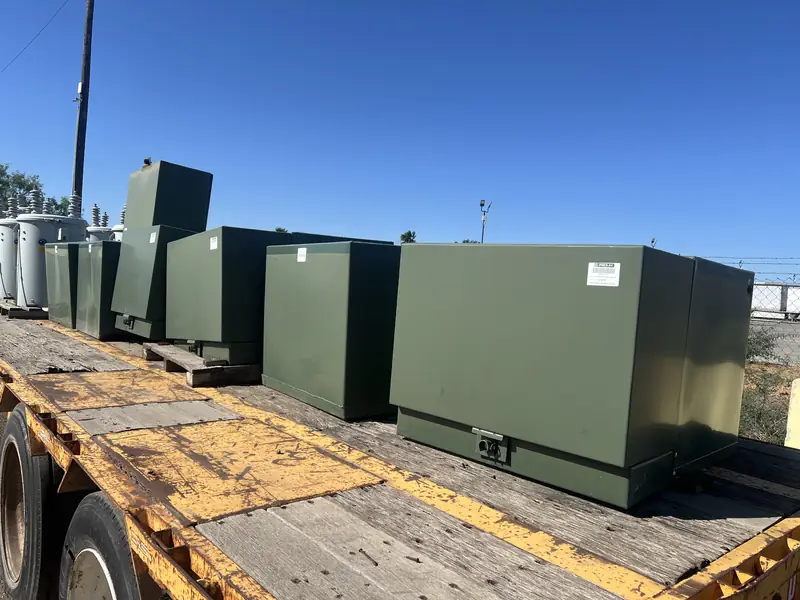
01How the Types of Transformers Fit Together
Transformer classifications overlap. A single unit can be a three-phase distribution transformer, liquid-filled, and pad-mounted at the same time. Each description answers a different question: what it serves, how it is insulated and cooled, or where it is installed.
For sellers, the useful starting point is the nameplate—not the cabinet color or the equipment's nickname. The kinds of transformers we buy are reviewed by actual specifications and condition, whether you have one spare unit or a mixed equipment yard.
- Application: distribution, power, unit substation or specialty.
- Construction: liquid-filled or dry-type.
- Installation: pad-mount, pole-mount, vault or station.
- Electrical configuration: phase, capacity, voltages and connections.
DIRAll Transformer Types We Buy
- Single-Phase Pad-Mount TransformersIdentify, document, and sell a used or surplus single-phase pad-mount transformer in California.
- Three-Phase Pad-Mount TransformersLearn how to identify, evaluate and sell a used or surplus three-phase pad-mount transformer in California.
- Pole-Mount TransformersLearn how California Transformer Buyer evaluates, offers on, and arranges pickup for used and surplus pole-mounted transformers.
- Substation & Power TransformersLearn how to identify, document, and sell a used or surplus substation power transformer in California.
- Unit Substation TransformersLearn how to identify, document and sell a used or surplus unit substation transformer in California.
- Liquid-Filled (Oil-Filled) TransformersLearn how to identify, document and sell a used or surplus liquid-filled transformer in California.
- Dry-Type TransformersIdentify your dry-type transformer, learn what affects resale value and see what information California Transformer Buyer needs to review it.
- Medium-Voltage Dry-Type TransformersLearn how to identify, document and sell a used or surplus medium-voltage dry-type transformer in California.
- Cast Resin (Cast Coil) TransformersLearn how to identify, document and sell a used or surplus cast resin transformer in California.
- Generator Step-Up (GSU) TransformersLearn how to identify a GSU transformer, what affects resale value, and what California sellers should provide for an offer.
- Solar & Inverter Step-Up TransformersSell a used or surplus California solar inverter step-up transformer with nameplate, configuration, condition, and site details.
- Battery Energy Storage (BESS) TransformersLearn how to identify a BESS transformer, what affects resale value and what California sellers should provide for an offer.
- Data Center TransformersLearn how to identify, document and sell used, surplus or new-surplus data center transformers in California.
- Network TransformersLearn how to identify, document and sell a used or surplus network transformer in California.
- Submersible & Vault TransformersLearn how to identify, document and sell used or surplus submersible and vault transformers in California.
- Mobile Substation TransformersLearn how to identify, value and sell a used or surplus mobile substation in California.
- AutotransformersLearn how to identify an autotransformer, what affects resale value, and what California sellers should share to request an offer.
- Grounding TransformersLearn how to identify a grounding transformer, what affects resale value and what to send California Transformer Buyer for an offer.
- K-Factor & Harmonic Mitigating TransformersLearn how to identify, document, and sell a K-rated or harmonic-mitigating transformer in California.
- Drive Isolation TransformersLearn how to identify, document, and sell a drive isolation transformer in California.
- Buck-Boost TransformersLearn how to identify, document and sell buck-boost transformers and small lots in California.
- Control & Industrial Control TransformersLearn how to identify, document and sell used, surplus or new-surplus control transformers in California.
- Instrument Transformers (CTs & PTs)Learn how to identify, document and offer used CTs, PTs and VTs for sale in California.
- Rectifier TransformersLearn how to identify, document and sell a used or surplus rectifier transformer in California.
- Furnace TransformersLearn how to identify a furnace transformer, what affects resale value, and what details to provide when requesting an offer in California.
02Distribution vs Power Transformers: Application Comes First
Distribution transformers generally deliver power closer to the end user. Examples include pole-mounted units serving homes, padmount units serving commercial properties, and low-voltage dry-type transformers supplying building loads.
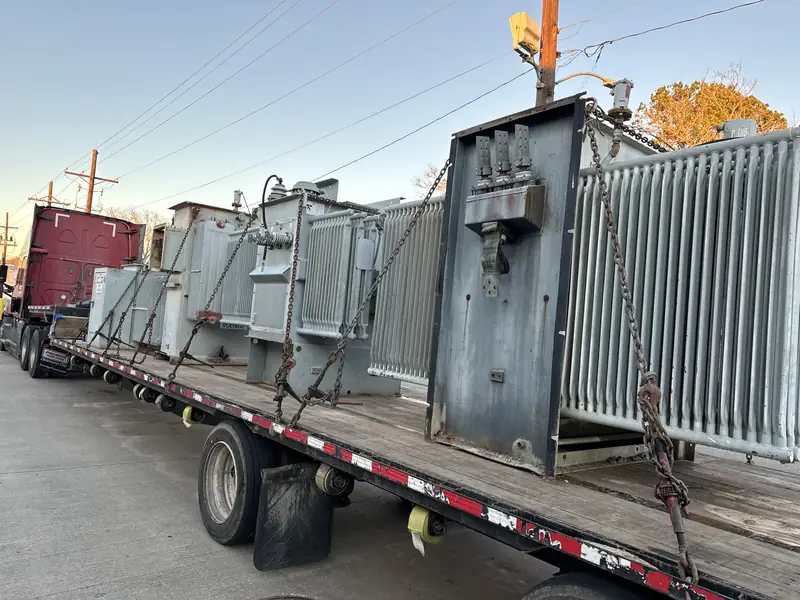
Power transformers typically serve substations, generation or larger industrial systems. Station-class equipment often has radiators, fans and tap-changing equipment. There is no universal capacity cutoff separating every distribution unit from every power transformer; application and design matter alongside kVA or MVA.
| Family | Typical role | Useful identification clues |
|---|---|---|
| Distribution | Supply local customer loads | Service voltages, pad or pole installation |
| Power / substation | Transfer power within larger systems | MVA ratings, cooling stages, tap changers |
| Unit substation | Integrate transformation with switchgear | Close-coupled equipment and connection layout |
| Specialty | Meet a specific electrical application | Purpose, connection diagram, design requirements |
03Pad-Mount and Pole-Mount Distribution Equipment
A pad-mounted transformer has a ground-level enclosure intended to restrict access to electrical connections. Single-phase units commonly supply 120/240 V loads; three-phase units commonly supply 208Y/120 V or 480Y/277 V. Check the plate rather than assuming the voltage from the installation.
Our guides to single-phase pad-mount transformers and three-phase pad-mount transformers explain these configurations separately. Three-phase cabinets can differ in feed arrangement, switching and connection requirements even when their capacities match.
Pole-mounted transformers are typically tank-style units designed for overhead distribution. Conventional and completely self-protected, or CSP, designs differ in protective features. For equipment already removed by authorized personnel, photograph the overall unit and accessible plate; see pole-mount transformer identification details.
04Liquid-Filled and Dry-Type Describe Construction
Liquid-filled transformers use insulating fluid to provide dielectric insulation and carry heat away from the windings. Mineral oil, natural ester such as FR3, and silicone are possible fluids. The liquid-filled transformer guide covers information relevant to these units.
Dry-type transformers use solid insulation and air rather than a liquid-filled tank. Low-voltage building units and medium-voltage VPI, VPE or cast-resin designs belong to this broad family. Record temperature rise, enclosure details and cooling information when stated.
Fluid type does not establish PCB concentration. Sellers should rely on testing, documentation and qualified environmental professionals. California has stricter rules for PCB-containing oil, and leaking or failed equipment needs an appropriate determination; this is not legal advice.
05Substation, Unit Substation and Specialty Configurations
Large substation and power transformers may list multiple capacities associated with cooling stages. A 12/16/20 MVA ONAN/ONAF/ONAF nameplate, for example, describes ratings under different cooling conditions—not three separate transformers.
A unit substation transformer is arranged for close coupling to primary or secondary switchgear. Connection locations and the equipment included in the sale matter, especially when the transformer remains part of an assembled lineup.
Specialty electrical transformer types include generator step-up, solar inverter step-up, BESS, grounding zig-zag, autotransformer and drive-isolation designs. Furnace, rectifier, K-factor and buck-boost units also require application-specific review. Send the complete plate and intended duty rather than labeling every specialty unit simply as a power transformer.
06Nameplate Details That Identify Your Transformer
Capacity alone is not enough to match equipment to another project. A 1000 kVA unit with the wrong primary voltage, secondary connection or impedance may not suit the intended system. Compare transformer kVA and MVA sizes and record every rating shown.
California systems use several primary voltage classes. For example, 12 kV, 16 kV and nominal 21 kV applications occur in different service areas. Use the actual nameplate voltage, not a regional assumption; our transformer voltage guide explains the distinctions.
- Manufacturer, serial number and manufacture year.
- All capacity ratings, phase and frequency.
- HV/LV voltages, delta/wye connections and taps.
- Impedance, BIL, cooling class and temperature rise.
- Fluid type, gallons, weight and PCB labels.
- Available factory tests and condition records.
07Send Photos for a California Purchase Review
Call or text Rocky at (951) 403-5738, or request a transformer offer through the contact form. Include safe-position photos, quantity, California location, condition and whether the equipment is used or never energized. Reviewing your transformer costs nothing and carries no obligation.
You must own the equipment or have authority to sell it. Qualified contractors or the serving utility handle isolation and disconnection—not sellers. Any written offer states what is included, responsibility for loading, rigging and freight, and payment terms before pickup.
FAQTransformer Types FAQ
Can you identify a transformer if its nameplate is unreadable?
Overall photos, equipment drawings, purchase records and existing test reports can help narrow down the family. They may not establish every electrical rating reliably. Send whatever documentation you already have, and Rocky can ask follow-up questions. Do not open compartments or approach exposed electrical parts to obtain missing information.
Are instrument transformers reviewed like distribution transformers?
Current transformers and potential transformers—CTs and PTs—serve measurement or protection functions rather than supplying ordinary building loads. Their ratios, accuracy classes, insulation ratings and intended use require a different review. Identify them specifically when submitting a mixed lot; do not describe them only by physical size or include them under a larger transformer's capacity.
Does a familiar brand make two transformers interchangeable?
No. Manufacturer information helps verify specifications, but interchangeability depends on electrical ratings, connections, impedance, insulation levels and installation requirements. Even two units from the same brand with matching kVA can have different applications. A qualified electrical professional should determine suitability for a proposed installation; purchase review is not engineering approval.
Can I offer several different transformer types together?
Yes. California Transformer Buyer reviews mixed lots as well as individual units. Provide a separate nameplate photo for each transformer where safely accessible, plus a quantity list and overall site photos. Identify missing parts, known failures and available records so the review does not assume that every unit has the same condition.
Is a transformer on my property necessarily mine to sell?
No. A transformer serving your property may belong to the utility, even if it sits on your land. Confirm ownership through your records or the serving utility before offering it for sale. Property owners cannot sell utility-owned equipment without authority, and its location or appearance does not establish ownership.