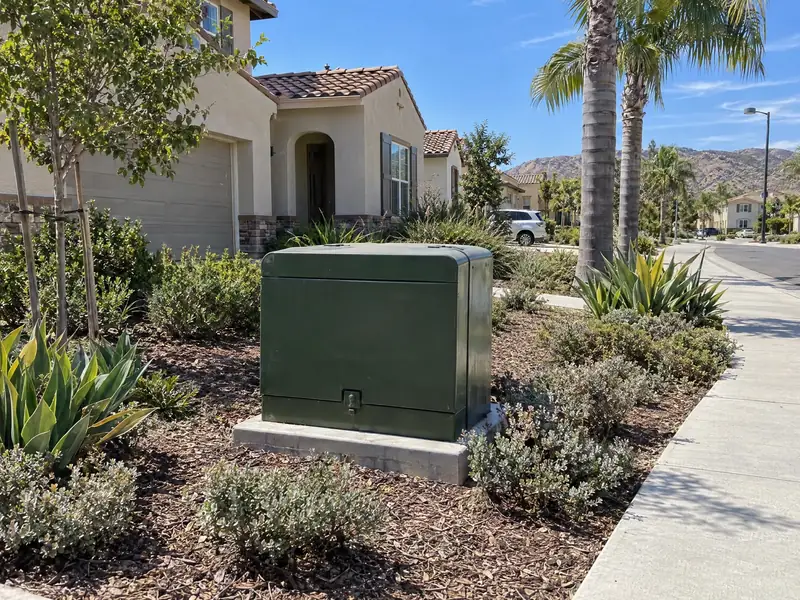
01What a Single-Phase Pad Mount Transformer Looks Like
A single-phase pad mount transformer is a liquid-filled distribution unit installed at ground level and supplied by underground primary cable. Its low, rectangular tank typically has a locked, hinged terminal cabinet. The equipment is designed to limit public access to energized connections, but the enclosure’s appearance alone does not establish its type or condition.
Start identification with the nameplate: look for a one-phase designation, kVA rating, primary and secondary voltages, and a connection or center-tap diagram. X1, X2, and X3 secondary terminals are common on 120/240 V designs. One or two high-voltage separable connector positions may be present. Two primary positions on a one-phase unit can indicate a loop-feed arrangement, not a two-phase transformer.
- Record manufacturer, serial number, and year if shown.
- Note the kVA, voltage, phase, and fluid type.
- Photograph the full unit and visible cabinet from a safe position, if authorized.
02How These Transformers Serve California Loads
The transformer reduces medium-voltage power arriving through underground cable to a lower voltage for customer use. A common secondary is 120/240 V single-phase, suitable for homes and small commercial loads. Residential subdivisions are a familiar application, as are light commercial properties with single-phase service requirements.
California primary systems vary by utility and service territory. Nameplates may show actual winding voltages such as 7.2, 12.0, or 19.92 kV line-to-neutral, or a system designation such as 12.47 GrdY/7.2 kV. Other designs include 20.78 GrdY/12.0 kV and 34.5 GrdY/19.92 kV systems. Verify the actual nameplate values; do not infer compatibility from a nearby utility’s typical voltage.
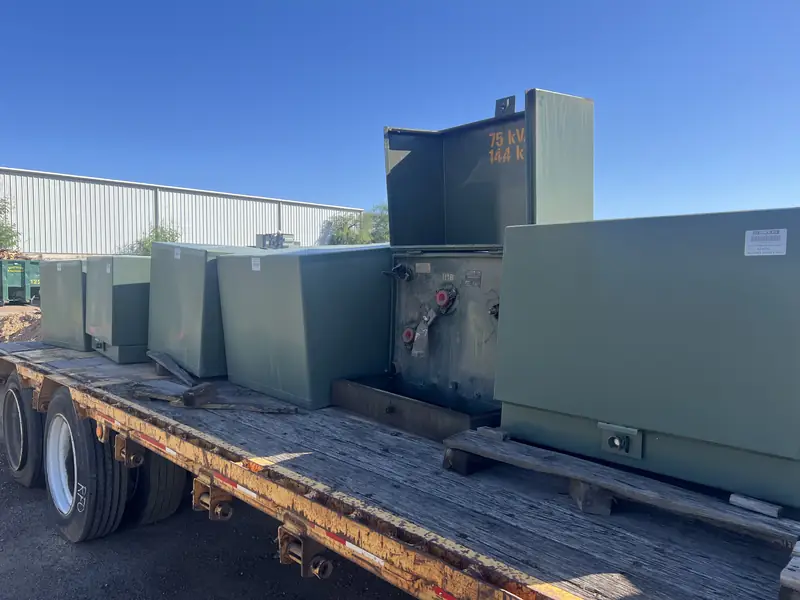
kVACommon Single-Phase Pad-Mount Sizes We Buy
03Common Single-Phase Pad Mount Transformer Sizes and Voltages
Common single-phase pad-mounted ratings run from 10 to 167 kVA, with 250 kVA included in the standard product scope. Special larger units may exist, but their availability is manufacturer-specific. Common ratings include 10, 15, 25, 37.5, 50, 75, 100, and 167 kVA; the nameplate is the best source for the exact rating.
For comparison, see details on common [25 kVA](25 kVA transformer ratings), [75 kVA](75 kVA transformer ratings), [100 kVA](100 kVA transformer ratings), and [250 kVA](250 kVA transformer ratings) units. A 250 kVA rating does not by itself confirm that a unit will suit a particular installation. Primary winding, secondary voltage, connection, and the buyer’s intended application all matter.
04Loop Feed, Radial Feed, Fuses, and Fluid Variations
A radial-feed arrangement has one primary cable connection path into the transformer. A loop-feed design provides a pass-through primary path, often reflected by two high-voltage connector positions. The number and arrangement of connectors are useful identification clues, but confirm the configuration from the nameplate and available equipment documentation.
Some units have bayonet fuses in the high-voltage compartment. Liquid insulation is commonly mineral oil or a natural ester such as FR3, and the unit is self-cooled. Record visible accessories, connector class if documented, and any labels or records describing the fluid. Do not open compartments or handle fluid to gather information.
05What Affects Resale Value of a Used Unit
A buyer assesses more than the kVA rating. Primary and secondary voltages, loop or radial arrangement, connector details, fluid type, condition, and demand for the configuration all help determine whether a unit can be resold for reuse. Leaks, corrosion, damaged bushings, missing parts, and uncertain PCB documentation can affect the evaluation.
New-surplus equipment that has never been energized may be assessed differently from used or pulled equipment. Test reports and records can help establish condition and fluid status. Ownership must also be clear: a property owner cannot sell a transformer that belongs to a utility. A green enclosure alone does not prove the unit’s type, condition, or acceptance by a utility.
06Information to Send for a Written Offer
To start a review, send a clear nameplate photo, overall photos, the quantity available, the California location, and a brief condition description. Rocky may ask follow-up questions about ownership, site access, test reports, fluid or PCB records, or missing components. Use the full nameplate rather than estimating voltage or rating from the enclosure.
California Transformer Buyer reviews used, pulled, surplus, and new-surplus equipment from sellers across California, from a single unit to a group of transformers. Sellers can [submit transformer details for an offer](sell your transformer) or text photos to (951) 403-5738. Reviewing a transformer costs nothing and creates no obligation.
- Nameplate and overall photos
- Quantity, location, and condition
- Test reports and fluid or PCB records, if available
- Confirmation that you own the unit or are authorized to sell it
07Removal Requires Qualified Electrical and Rigging Planning
Do not disconnect, de-energize, open, drain, or move the transformer to prepare it for sale. The owner’s qualified electrical contractor or serving utility handles electrical isolation and disconnection. Backfeed from solar, battery, or generator systems also needs to be considered by qualified personnel.
Describe access constraints, including the unit’s position, nearby structures, and any known limits for loading equipment. Before pickup, the written offer states what is included, who handles loading or rigging and freight, and the payment terms and timing. Review the [transformer removal and pickup process](transformer removal and pickup planning) before arranging work at the site.
08Why California Sellers Contact a Transformer Buyer
A replacement project, site upgrade, decommissioning, or surplus inventory can leave a serviceable pad-mounted unit unused. Rather than treating every unit as scrap, sellers can provide its nameplate and condition information for a reuse-focused review. California Transformer Buyer considers single-phase equipment as well as other [pad-mount transformer types](pad-mount transformer buying options) and [three-phase pad-mounted units](three-phase pad-mount transformers).
The process gives sellers a written record of the offer and the responsibilities agreed before pickup. For a direct review, call or text Rocky at (951) 403-5738, or use the [contact form](contact California Transformer Buyer). The buyer serves California sellers only.
FAQSingle-Phase Pad-Mount Transformer FAQ
Can I sell a transformer if the nameplate is hard to read or missing?
Send the clearest photos available, including the overall unit, cabinet, and any remaining labels. Include dimensions or other markings only if you can record them without opening or moving equipment. A missing or unreadable nameplate may limit what can be confirmed, so the buyer may need additional documentation or details before deciding whether to make an offer.
Does a green enclosure mean this is a utility-approved pad-mount transformer?
No. Color is not enough to identify the electrical design, ownership, condition, or whether a utility would accept the unit for a particular installation. Check the nameplate, connection diagram, and available records. California Transformer Buyer is not affiliated with or endorsed by any utility, and any proposed reuse should be evaluated for the intended application by qualified professionals.
What if I do not have PCB or fluid documentation?
Tell the buyer what records are available and provide clear photos of labels from a safe position. Do not sample or drain the transformer yourself. PCB status and fluid management should be based on testing, documentation, and advice from qualified environmental professionals. Requirements depend on the equipment and its records; this information is not legal advice.
Will a single-phase unit work as a replacement for another transformer?
Not necessarily. The phase, kVA, primary winding voltage, secondary voltage, connection, taps, and feed arrangement all need to match the application. A transformer’s nameplate may also distinguish its winding voltage from the system designation. Have a qualified electrical professional confirm suitability before planning installation or representing the unit as interchangeable.
Can I sell a transformer installed at a property if a utility owns it?
Only the owner or someone authorized by the owner can sell the equipment. A transformer located on private property may still belong to the serving utility, so confirm ownership before requesting an offer. If ownership is uncertain, check your project or service records and contact the relevant utility; location on your site alone does not establish ownership.
What happens after I send photos and equipment details?
Rocky reviews the information and may ask follow-up questions about test reports, ownership, fluid or PCB records, condition, and site access. If the unit is suitable for an offer, the written terms explain the price, what is included, who handles loading or rigging and freight, and payment terms and timing. Pickup is arranged after the terms are agreed.