01How Transformer Removal Fits Into Your Sale
Transformer removal is part of the sale plan—not an assumed service with identical terms at every site. A disconnected pad-mounted unit beside an accessible driveway presents different requirements from a station-class transformer behind switchgear or inside a restricted industrial yard.
Start by calling or texting Rocky at (951) 403-5738 with the quantity, exact California location, nameplate photos and overall condition. California Transformer Buyer reviews the equipment and asks about ownership, electrical status, test records and access before providing a written offer.
The offer states what is included, who handles loading and rigging, who handles freight, and payment terms and timing. Reviewing your transformer costs nothing and there is no obligation. The transformer buying process explains the steps from initial review through pickup.
- Confirm ownership or authority to sell.
- Document the equipment and its current condition.
- Agree on removal responsibilities before scheduling.
- Coordinate electrical clearance, loading and freight.
02Electrical Clearance Comes Before Loading
Your qualified electrical contractor or the serving utility must handle de-energizing and disconnecting. California Transformer Buyer never asks property owners or other unqualified sellers to perform electrical work. A planned shutdown or a unit that appears unused is not proof that it is electrically safe.
Qualified personnel must address isolation, lockout, voltage verification and grounding as applicable under California safety requirements. Solar systems, batteries and generators can create backfeed hazards that must be included in the clearance plan. Only qualified personnel may open electrical compartments after the required safety steps.
Ownership is a separate requirement. A utility-owned transformer on your property is not yours to sell; utility release documentation may be needed where applicable. For project coordination, use the transformer removal checklist for facility managers to organize records and responsibilities without treating it as an electrical work procedure.
- Report whether equipment is energized, de-energized or disconnected.
- Identify the contractor or utility responsible for electrical clearance.
- Take photographs only from safe, authorized positions.
03Photos, Nameplate Data and Weights Needed for Pickup
Send a readable, straight-on nameplate photograph and external views of all accessible sides. Useful images show radiators, bushings, valves, cabinet condition, accessory plates and ground-level clearances. Do not open compartments or enter restricted areas to obtain them.
The nameplate identifies kVA or MVA rating, primary and secondary voltages, cooling class, fluid type and weight information. Ratings do not establish lifting weight: two 1000 kVA transformers can differ in construction, accessories and fluid volume. Distinguish total operating weight from shipping weight and component weights.
Include known storage conditions, leaks, corrosion, physical damage, repairs and the date last operated. Factory and service records—such as turns ratio, winding resistance, insulation, appropriate dielectric tests, liquid tests and DGA where applicable—help assess condition. This is a records list, not a testing procedure.
- Overall length, width and height, including projections
- Operating weight and documented shipping configuration
- Manufacturer-identified lifting or rigging points
- Included and missing accessories
- Existing fluid and PCB records
04Site Access Determines Crane, Forklift or Roll-Off Options
Access planning starts at the transformer and continues to the truck’s loading position. Report gate openings, turns, slopes, surface condition, overhead obstructions and available staging space. Photographs should show the route, not just the equipment.
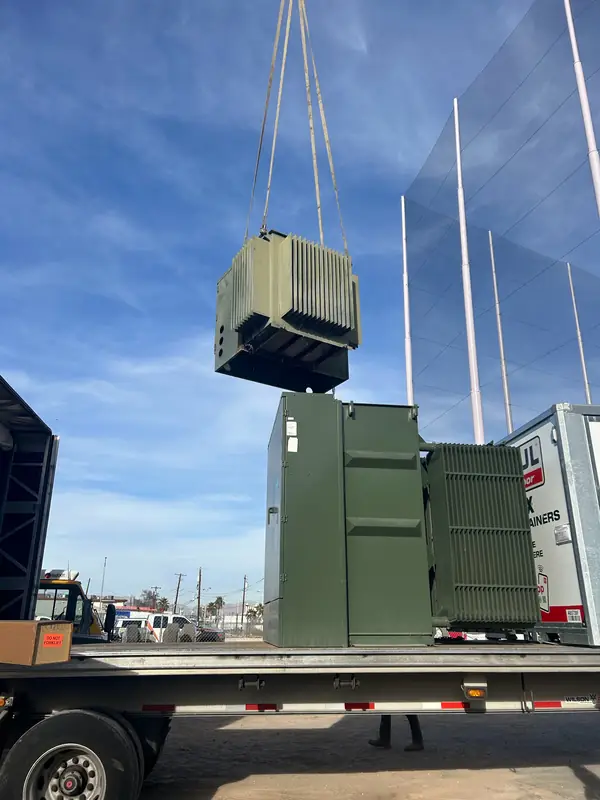
The qualified rigging provider selects the lifting method based on actual weight, lift points, reach and site conditions. Forklift suitability depends on rated capacity at the required load center and an appropriate support arrangement. Crane planning must account for lifting radius, setup space and ground support.
A roll-off arrangement may suit some equipment already on a suitable transport platform, but it is not interchangeable with a crane or forklift. Do not assume that a transformer can be dragged, tipped or lifted by cabinet edges, radiators or bushings. The pad-mount transformer selling page covers equipment details relevant to these common ground-level units.
| Method | Planning considerations | Important limitation |
|---|---|---|
| Forklift | Weight, load center, fork access and travel surface | Rated capacity must fit the actual lift |
| Crane | Lift radius, rigging points and setup area | Reach and ground conditions affect capacity |
| Roll-off arrangement | Suitable platform and loading geometry | Not appropriate for every transformer |
05Trailer Selection and California Heavy-Haul Permits
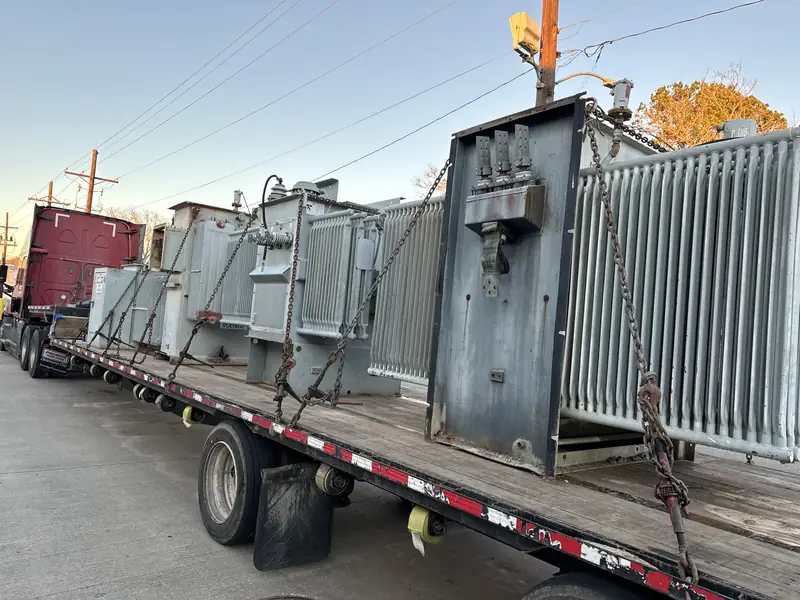
Transformer rigging and hauling must be planned together. A flatbed may suit equipment within the carrier’s loading and clearance limits. Step-deck or lowboy trailers can reduce loaded height, but trailer choice still depends on weight distribution, securement, loading method and the route.
Caltrans issues oversize and overweight permits for state-highway loads exceeding common limits such as 8 feet 6 inches in width, 14 feet in height or 80,000 pounds gross. Other axle, vehicle and route restrictions also matter. Local roads may require separate approvals; a state permit does not resolve every access issue.
Large substation transformers may require a documented shipping configuration with radiators or bushings removed and, where appropriate, nitrogen or dry-air protection. Qualified specialists determine those requirements; sellers should not dismantle or drain equipment themselves. See selling substation and station-class transformers for the equipment information needed for review.
- Use loaded dimensions, not tank dimensions alone.
- Account for trailer height and projecting accessories.
- Identify restricted approaches and local-road requirements.
- Confirm responsibility for permits and freight in writing.
06Oil Containment, Leak Prevention and PCB Documentation
Disclose active leaks, damaged valves, staining and known fluid loss before pickup. The transport plan should address equipment condition, securement, containment needs and protection of vulnerable fittings. Leak controls must suit the actual unit; a general freight arrangement is not a substitute for evaluating damaged oil-filled equipment.
A working transformer sold for reuse is equipment, but leaking units, drained oil and failed transformers require a proper determination of their regulatory status. In California, regulated used oil or waste hauling can require registered hazardous-waste transporters and manifests. A bill of lading alone does not replace required environmental documentation.
Federal non-PCB classification means below 50 ppm, not zero PCBs. California excludes oil containing 5 ppm or more PCBs from its used-oil category and has stricter rules for PCB-containing oil. Unknown status can trigger regulatory assumptions until testing or qualifying documentation establishes concentration.
Rely on testing, records and qualified environmental professionals to determine the correct pathway; this is not legal advice. Discuss failed or leaking equipment during the initial review, and consult the scrap and failed transformer selling page for condition-specific information.
07Define What Leaves the Site—and What Stays
An agreement to remove an old transformer does not automatically include concrete demolition, conduit removal or site restoration. State whether the concrete pad, anchors, conduits, grounding components, fencing and adjacent electrical equipment stay behind. Any additional work needs an expressly assigned scope.
Also identify which accessories travel with the transformer: radiators, fans, gauges, switches, controls and loose parts can affect both its value and transport plan. For a unit substation, clarify whether the sale covers the transformer alone or associated sections.
Where several units are being sold, label photographs and records so each serial number matches the correct equipment and included parts. A multi-unit transformer liquidation plan can help define lot boundaries, staged access and removal obligations before trucks arrive.
- Transformer and accessories included in the sale
- Pad, conduits and other items remaining on site
- Loading and freight responsibilities
- Any restoration obligations expressly agreed upon
08Written Terms and Pickup Documentation
Before transformer pickup, review the written offer against the actual site conditions. Electrical clearance, loading arrangements, freight responsibilities, included equipment and payment terms should be settled before scheduling. If access or condition changes, disclose that change before dispatch.
A bill of sale documents the ownership transfer and should identify the equipment and agreed terms. A bill of lading documents the shipment, including the units or pieces loaded and the parties involved in transport. Applicable environmental manifests or other records serve separate purposes.
To request an offer, text safe external photos and the nameplate to Rocky at (951) 403-5738, or use the contact form to request a transformer offer. Include your California location, quantity, electrical status, known weight, leaks and access restrictions so the removal discussion starts with useful facts.
FAQTransformer Removal & Pickup FAQ
Can I request an offer while the transformer is still energized?
Yes. You can submit existing records and photographs taken from safe, authorized positions while reporting that the transformer remains energized. Review does not authorize access to electrical compartments or loading. Your qualified electrical contractor or serving utility must handle electrical isolation and disconnection before removal can proceed under the agreed plan.
Is transformer removal included at no charge?
Do not assume removal is free or automatically included. Site access, equipment weight, loading method, freight and environmental condition all affect the transaction. California Transformer Buyer states who handles loading, rigging and freight in the written offer. Review those responsibilities and payment terms before accepting the offer or scheduling pickup.
What if I cannot find the transformer’s shipping weight?
Send the readable nameplate, available drawings, equipment dimensions and any manufacturer or service records. State clearly that shipping weight is unknown rather than estimating it from kVA alone. The loading and hauling plan needs a reliable weight and shipping configuration; the qualified providers may need additional documentation before selecting equipment.
Can a transformer be picked up from inside a building or fenced enclosure?
That requires a site-specific review. Door and gate openings, overhead clearance, floor or ground conditions, turns and the route to the truck all matter. Send external access photographs and available measurements without entering unsafe areas. A written offer and removal plan must address the actual restrictions rather than assuming ordinary outdoor loading access.
Does a non-PCB label eliminate the need for fluid records?
No. A label is useful documentation, but federal non-PCB classification does not mean zero PCBs, and California has stricter rules for PCB-containing oil. Available test reports, manufacturing records and service history help establish status. Qualified environmental professionals should determine whether documentation is sufficient and what management or transport requirements apply.
When will I receive payment for the transformer?
Payment terms and timing are stated in the written offer before pickup. Do not assume payment happens at loading or on the same day. Confirm the agreed sequence for equipment identification, ownership transfer, pickup and payment when reviewing the offer, and raise any required purchasing or accounting paperwork before the removal date.