01Dry-Type vs Oil-Filled Transformers: The Construction Difference
The main difference is the insulation and cooling system, not the electrical purpose. Both types transfer power between circuits through magnetic coupling. Their voltage ratio, capacity, impedance and connections determine whether they fit a particular installation.
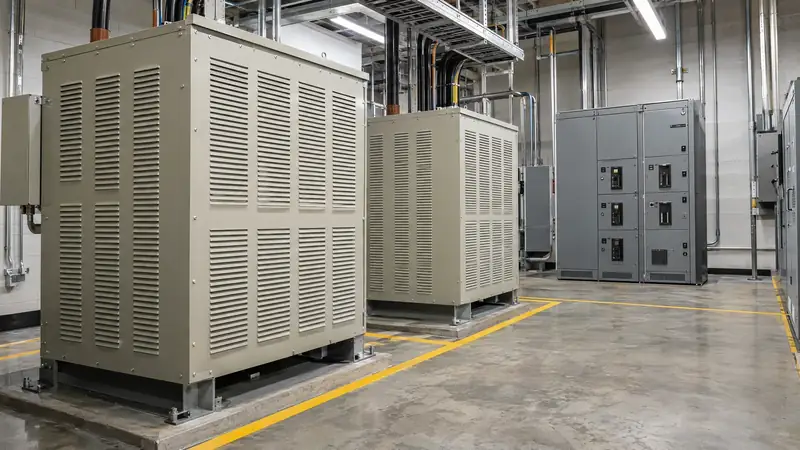
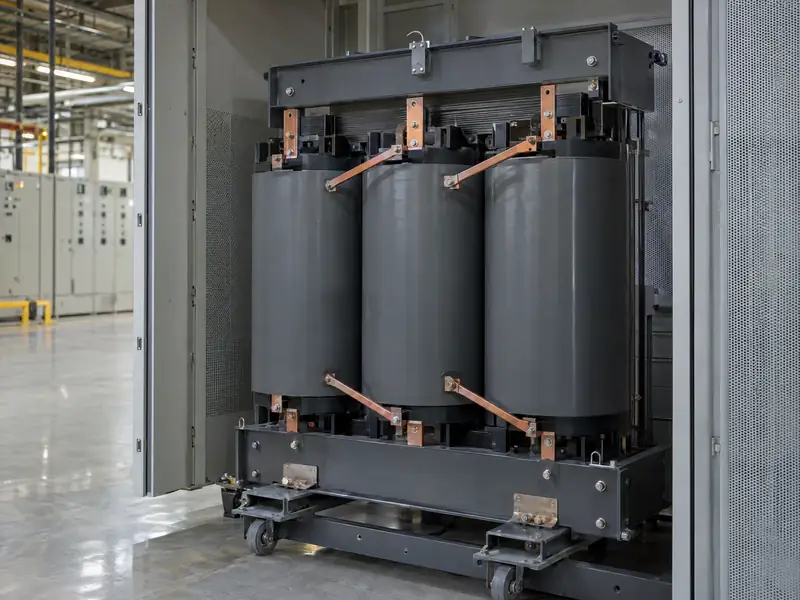
Dry-type units have insulated windings without an insulating liquid bath. Designs include ventilated low-voltage units, vacuum-pressure-impregnated or encapsulated windings, and cast-resin medium-voltage transformers. Natural air circulation or fans remove heat, depending on the design.
Oil-filled units place the core and windings in a tank containing dielectric liquid. Mineral oil is common, but liquid-filled equipment can also use natural ester or silicone. The broader term “liquid-filled” is more precise when the fluid is not petroleum-based; always identify the actual fluid from records.
For a closer look at winding construction and common configurations, see our dry-type transformer guide.
| Feature | Dry-type | Liquid-filled |
|---|---|---|
| Insulating system | Solid winding insulation | Dielectric liquid plus solid insulation |
| Heat removal | Air circulation; fans where fitted | Liquid circulation; radiators or fans where fitted |
| Condition concerns | Moisture, dust, insulation damage | Leaks, fluid condition, bushings |
| Useful records | Electrical tests and inspection history | Electrical tests, fluid tests and PCB records |
| Removal planning | Weight, enclosure and building access | Weight, liquid, tank and site access |
02Where Each Type Fits—and Why Location Does Not Prove the Type
Low-voltage dry-type transformers commonly serve commercial buildings and industrial facilities. A three-phase unit might supply 208Y/120 V loads from a 480 V source. Medium-voltage dry types also appear in unit substations, so “dry-type” does not necessarily mean small or low voltage.
Liquid-filled transformers are common in outdoor distribution and larger substation service. Pad-mounted, pole-mounted and station-class equipment may all contain insulating liquid. Larger power transformers often include radiators, fans and tap-changing equipment.
Neither location nor enclosure shape is enough to establish construction. Outdoor-rated dry types exist, and liquid-filled equipment can serve indoor installations where the applicable design and fire-protection requirements are met. Our pad-mount, pole-mount and substation comparison explains these configuration differences.
For resale, use exact nameplate voltages rather than a local utility’s nominal system description. A 12,000 V delta primary and a 12,470GrdY/7,200 V primary are not interchangeable descriptions, even though both may be called 12 kV-class equipment.
03Maintenance History: Different Evidence for Different Insulation Systems
A used transformer’s maintenance history helps distinguish normal service wear from unresolved damage. Dry types do not require insulating-liquid maintenance, but they are not maintenance-free. Dust accumulation, blocked ventilation, moisture exposure, overheating and damaged insulation can affect serviceability.
For liquid-filled units, buyers consider tank leaks, bushing condition, corrosion, cooling accessories and available fluid reports. Dissolved gas analysis, often called DGA, can provide evidence about internal operating conditions. A single favorable oil result does not establish the condition of the entire transformer.
Existing insulation-resistance, turns-ratio and factory test reports can help with either construction. Their usefulness depends on test methods, dates and what happened afterward. Provide available records rather than arranging informal testing or opening equipment yourself.
- State whether the unit operated normally before retirement.
- Disclose known overheating, flooding, faults or prolonged outdoor storage.
- Identify missing fans, covers, bushings, gauges or other accessories.
- Include repair history and the date of the latest available tests.
04Resale Value Depends on the Electrical Match, Not Just Oil Content
There is no reliable rule that an oil-filled transformer is worth more than a dry type, or vice versa. A usable configuration with documented condition may have a stronger reuse case than a larger unit with unusual voltages, missing parts or uncertain history.
Buyers review kVA or MVA, phase, frequency, primary and secondary voltages, connections, taps, impedance and BIL. Cooling class and temperature rise also matter. A liquid-filled unit’s multi-stage rating, such as 12/16/20 MVA, should not be reduced to only its highest rating.
Winding material, age, accessories and removal complexity further affect an offer. A common 480Y/277 V secondary may fit different projects than an uncommon 600 V secondary. However, common voltage alone does not establish demand or compatibility.
When you want to sell a transformer, separate proven facts from assumptions. Our used transformer buying page covers previously energized equipment, while the new-surplus transformer page addresses units that have never been energized. Unused equipment still needs condition and storage review.
05PCB Documentation and California Oil Rules
PCB classification is especially important for liquid-filled equipment with incomplete history. Under TSCA and 40 CFR 761, non-PCB means below 50 ppm; PCB-contaminated electrical equipment means 50 ppm or more but below 500 ppm; and a PCB transformer contains 500 ppm or more. Non-PCB does not mean zero PCBs.
Unknown status requires careful review. Pre-July 2, 1979 mineral-oil equipment with unestablished concentration must be assumed PCB-contaminated; an unknown manufacturing date triggers that mineral-oil assumption too. Pre-July 2, 1979 transformers containing at least three pounds of non-mineral fluid with unestablished concentration must be assumed PCB transformers. If both date and fluid type are unknown, assume PCB transformer.
Section 761.2 permits a non-PCB assumption for equipment manufactured after July 2, 1979, but testing, manufacturer documentation and complete service records are preferable for a buyer. EPA’s May 1979 PCB manufacturing ban was not a ban on manufacturing all transformers, nor does a later manufacture date guarantee uncontaminated fluid.
California adds separate requirements. Health and Safety Code 25250.1 excludes oil containing 5 ppm or more PCBs from the state’s “used oil” category. Title 22 lists PCB thresholds of 50 mg/kg total and 5 mg/L soluble extract. These provisions do not mean every transformer at 5 ppm is automatically hazardous waste.
Transfer eligibility depends on classification, leaks, authorized use, destination, marking and transport. Section 761.20 includes exceptions for intact, nonleaking equipment, and section 761.30 supplies use conditions. Draining, dilution or retrofilling alone does not establish lawful reclassification. Sellers should rely on testing, documentation and qualified environmental professionals; this guide is not legal advice.
06Removal Planning: Dry Does Not Mean Easy to Move
Dry-type transformers can be heavy and difficult to remove from electrical rooms, rooftops or close-coupled equipment lineups. Door dimensions, overhead clearance, stairs, enclosure condition and lifting provisions affect the plan. Liquid-filled units add tank integrity, fluid status and potential environmental concerns.
Only the owner’s qualified electrical contractor or serving utility should de-energize and disconnect equipment. Qualified personnel must address isolation, voltage testing, grounding and possible backfeed from solar, batteries or generators. Sellers should not open compartments, drain or sample liquid, or move equipment themselves.
A working transformer transferred for reuse is equipment, but leaking units, drained oil and failed units require a proper determination. Regulated used oil or waste transport can require registered hazardous-waste transporters and manifests in California. Large loads may also need Caltrans and local-road permits.
The transformer removal and pickup guide explains access information to provide. Written terms should identify who handles rigging, loading and freight before pickup is scheduled.
07What to Send for a Dry-Type or Liquid-Filled Offer
Start with readable nameplate photos, overall photos, quantity, California location and current condition. Take photos only from a safe position where you are authorized to be. Do not open an energized compartment to obtain a missing detail.
For liquid-filled equipment, include fluid type, gallons, PCB labels and available laboratory or service records. For dry types, include insulation design, temperature rise, enclosure information and any fan-assisted ratings shown on the plate. Our transformer quote photo checklist helps organize the submission.
- Manufacturer, serial number and manufacture year.
- All kVA/MVA stages, phase and frequency.
- HV/LV voltages, connections and tap positions.
- Impedance, BIL, cooling class and temperature rise.
- Total weight and winding material, if stated.
- Ownership, operating history, test reports and access limitations.
08Request a California-Only Review From Rocky
California Transformer Buyer reviews used, removed, surplus and new-surplus transformers from sellers throughout California, from single units to mixed lots. You must own the equipment or have authority to sell it. Utility-owned equipment on your property is not yours to sell.
Call or text Rocky at (951) 403-5738, or request a transformer offer through the contact form. Reviewing your transformer costs nothing and carries no obligation. Rocky may request additional specifications, test records, fluid documentation or access details.
If an offer is made, the written terms state what is included, who handles loading or rigging and freight, and payment terms and timing. Construction type starts the review; electrical fit, documented condition and a workable removal plan determine the next steps.
FAQDry-Type vs Oil-Filled Transformer FAQ
Can a dry-type transformer replace an oil-filled transformer with the same kVA?
Not on kVA alone. A qualified designer must check voltage ratio, connections, impedance, BIL, cooling, temperature rise, enclosure, clearances and protection requirements. Physical interfaces and fire-protection requirements may also differ. Equal capacity does not establish electrical or installation compatibility, so a seller should describe the equipment rather than promise it is a direct replacement.
Are natural-ester transformers considered dry-type?
No. Natural ester is an insulating liquid, so a transformer using it is liquid-filled even though the fluid is not mineral oil. Silicone-filled units are also liquid-filled. Identify the fluid accurately from manufacturer and service records, and provide any history of fluid changes. A fluid’s trade name alone does not establish the unit’s current condition or PCB concentration.
Does a non-PCB nameplate eliminate the need for other records?
A label is useful evidence, but its wording and date matter. “No PCBs at time of manufacture” describes manufacture, not necessarily every later servicing event. Buyers may request laboratory results and service records to evaluate current status. Non-PCB also means below 50 ppm under the federal classification, not necessarily zero, and California oil-management requirements still need separate review.
Can I sell a transformer that is still energized?
You can submit information about equipment still in service if you own it or have authority to sell it. State that it remains energized and explain the planned retirement schedule. Any eventual removal requires qualified isolation and disconnection. Do not approach restricted areas or expose live parts for photos; explain which information is unavailable safely.
Do newer efficiency standards prevent resale of an older transformer?
DOE distribution-transformer efficiency standards apply to manufacture; they do not make existing used or surplus units illegal to resell merely because newer standards exist. Applicability depends on the equipment category and manufacture date. A prospective installation still needs its own technical and code review, and buyers may consider efficiency when deciding whether a unit fits a project.
Is a failed dry-type transformer automatically scrap?
A failed unit needs condition-specific review. Repair feasibility, insulation damage, winding condition, missing parts and configuration affect whether reuse or material recovery is practical. Liquid-filled failures also raise fluid and environmental questions. Describe the failure honestly and send available reports; neither construction type guarantees acceptance, repairability or a particular resale outcome.