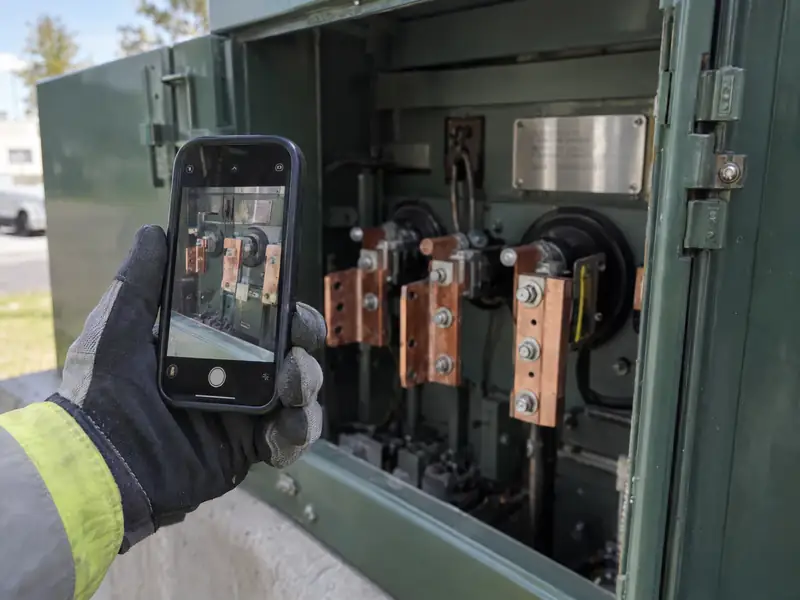
01What Photos to Send for an Initial Transformer Review
The best photo set answers three questions: what is the transformer, what condition is it in, and how can it leave the site? Start with identification, then document the exterior and surrounding access. California Transformer Buyer reviews used, removed, surplus and new-surplus units located in California.
You do not need a professional camera. Clear phone photos are useful when the plate text is readable and the equipment is shown without cropped corners. If you are unsure of the equipment family, the pad-mount, pole-mount and substation identification guide can help describe it without guessing.
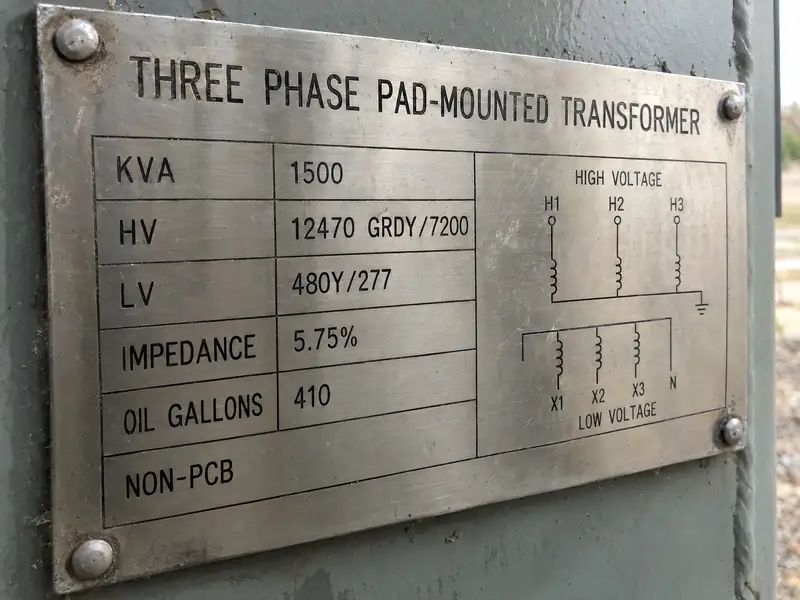
- One straight-on photo of the complete main nameplate.
- Close-ups of small plate text and the connection diagram.
- One overall view showing the complete transformer.
- Front, rear and both sides, wherever safely accessible.
- Visible bushings, gauges, radiators, fans and accessory plates.
- Base, supports, visible valves, leaks, corrosion and damage.
- Compartment interiors only through qualified, authorized personnel.
- Wide views of the route to the pickup or loading area.
02Make the Nameplate Readable Before Adding More Photos
A nameplate photo is usually the most useful image in the package. Photograph the entire plate straight-on from a safe position, then add closer views if one image cannot resolve every line. Keep original-resolution files; a screenshot or heavily compressed image can make voltage notation and serial numbers unreadable.
Include separate connection diagrams, tap tables and accessory plates rather than assuming the main plate contains everything. Preserve the manufacturer's exact wording, including legacy cooling designations and slash-voltage notation. If text is missing or obscured, report it as unreadable instead of supplying an estimate.
For a multi-stage substation transformer, capture every kVA or MVA rating and its associated cooling class and temperature rise. A 12/16/20 MVA ONAN/ONAF/ONAF plate does not describe a 20 MVA self-cooled unit. Likewise, 208Y/120 V, 240 V delta and 480Y/277 V are different configurations, not interchangeable descriptions.
- Manufacturer, model, catalog number, serial and manufacture date.
- Every kVA/MVA stage, phase, frequency and temperature rise.
- Exact HV, LV and tertiary voltages, currents and connections.
- Tap table, changer type and documented selected setting.
- Impedance percentage and its stated reference basis.
- BIL, insulation class, fluid type and fluid volume.
- All listed weights and documented winding material.
- Connection diagram, PCB labels and special-duty markings.
Keep Similar-Looking Ratings Separate
BIL is an impulse-withstand rating, not operating voltage. Total transformer weight is not copper weight, and terminal material does not establish winding material. A delta-wye description alone also does not justify assigning an IEC vector group such as Dyn11.
03Show All Sides, Cabinet Condition and Included Equipment
Take an overall view first so close-ups have context. Then show each safely accessible side, including the cabinet exterior, tank, doors, hinges, enclosure panels and any attached equipment. If a wall, fence or adjacent energized equipment prevents a view, say which side could not be photographed.
For a pad mount or padmount unit, show the cabinet arrangement and exterior labels without opening it. For station-class equipment, include the complete radiator banks, fans, conservator if present, and attached control cabinets. See the three-phase pad-mounted transformer guide for configuration details that may affect a buyer's review.
Identify which accessories are included in the sale. Nearby switchgear, loose elbows, spare radiators or a network protector should not be assumed to belong to the transformer. Photograph separate items and connect them to the correct unit in your notes.
- Show missing panels, bent doors, dents and damaged supports.
- Include both a wide view and a close-up of significant damage.
- Photograph visible shipping labels on crated or skid-mounted units.
- State whether packaging or surrounding structures block inspection.
04Compartment and Bushing Photos Must Stay Within Safe Access
Do not open electrical compartments to improve a quote package. Photograph only equipment you are authorized to access, from a safe position. De-energizing, disconnecting and establishing safe access belong to the owner's qualified electrical contractor or serving utility, not the seller taking photos.
An apparently idle transformer may still have an electrical hazard. Solar, batteries and generators can create backfeed, and a status label is not a substitute for qualified isolation and verification. Compartment images should be provided only when qualified personnel have completed proper isolation, lockout, voltage verification and grounding as applicable.
When safely available through those personnel, interior photos can document H/X terminal labels, neutral connections, loop or radial feed arrangements, live-front or dead-front construction, interface ratings, fuses, switches and protection devices. Exterior views of visible bushings can show chipped porcelain, damaged housings or missing parts, but photographs cannot establish electrical integrity.
- Report energized status separately from disconnected condition.
- Do not reach through barriers or approach exposed conductors.
- Do not reposition cables, operate switches or change taps.
- Send existing qualified inspection photos if available.
05Capture Gauges, Radiators, the Base and Any Leakage
Photograph visible temperature, liquid-level and pressure/vacuum gauges where readable from a safe position. Include their labels and note when the images were taken. A gauge reading is a snapshot; it does not prove serviceability or establish the cause of an abnormal indication.
Show radiators, cooling fans, externally visible valves and the tank base. Include ground-level views of supports, skid members, corrosion and staining. For a suspected leak, provide a wide image showing its location and a closer image from a safe position; report whether leakage is known to be active or its timing is unknown.
Dry-type units need different condition evidence: enclosure condition, visible ventilation openings and any safely visible dust, water damage or overheating marks. The dry-type versus oil-filled transformer guide explains why these inspection details differ. Do not remove covers or disturb equipment to expose them.
- Visible bushing seals and tank seams.
- Radiator damage, corrosion and missing fans.
- Base deterioration and damaged mounting points.
- Stained pavement, containment areas and visible fluid.
- Accessory plates on gauges, fans, pumps or controls.
06Pair Fluid and PCB Labels with Actual Records
For liquid-filled equipment, photograph the fluid designation, volume and every PCB-related label that is safely visible. Identify whether the stated fluid is the original fill or a documented retrofill. A repair or retrofill date should not be reported as the original manufacturing date.
Attach available laboratory certificates with the sample date and equipment serial match. Federal non-PCB classification means below 50 ppm, not necessarily zero PCBs. Unknown older equipment can require regulatory assumptions until testing or qualifying documentation establishes its status.
California has stricter rules for PCB-containing oil, and the correct handling pathway depends on testing and documentation. Rely on qualified environmental professionals rather than interpreting a label as disposal clearance. The California PCB transformer guide provides additional context; this information is not legal advice.
- Include laboratory results, not just a handwritten concentration.
- Attach relevant repair, retrofill and service records.
- Share available liquid dielectric and DGA reports.
- Do not drain or sample fluid yourself for a quote.
Photos and Tests Answer Different Questions
A clean tank can still have internal problems, while exterior rust alone does not establish winding condition. Available factory and service tests add evidence that photos cannot provide. The transformer oil testing and DGA guide explains the role of liquid-condition records.
07Photograph the Access Route, Not Just the Transformer
Removal planning begins with the space around the unit. Show the transformer in relation to buildings, fences, gates, bollards, curbs and adjacent equipment. Add wide views along the likely route to a loading area without entering restricted zones.
Include known dimensions, operating and shipping weights, and available lifting drawings. Distinguish assembled operating weight from a documented transport configuration. For large substation transformers, shipping arrangements may differ substantially from the installed arrangement and require specialist planning.
Photos help identify access questions, but they do not certify a lifting point, pavement capacity or crane setup. Do not move the transformer or clear electrical barriers for pictures. Review transformer removal and pickup planning for the information needed to define responsibilities.
- Gate openings and turns along the access route.
- Overhead obstructions visible from ground level.
- Steps, slopes, curbs and changes in surface.
- Space around the base and loading area.
- Known site restrictions and removal obligations.
08Organize the Photo Package and Request a Written Offer
For multiple transformers, assign each unit a simple identifier and keep its photos, nameplate and records together. Use filenames such as Unit-A-nameplate, Unit-A-front and Unit-A-access. This prevents one unit's voltage, condition or test report from being attributed to another.
Alongside the images, provide quantity, exact California location, ownership or authority to sell, operating status and date last operated if known. Explain storage conditions, repairs, known overload or fault exposure, flooding, missing accessories and who is responsible for removal. Utility-owned equipment cannot be sold by a property owner without the appropriate authority or release.
Text Rocky at (951) 403-5738 or use the transformer offer request form. Reviewing your transformer costs nothing and there is no obligation. Rocky may request additional records or photos before issuing a written offer stating what is included, loading and rigging responsibilities, freight, and payment terms and timing.
FAQWhat Photos to Send for a Transformer Quote FAQ
Can I request a quote if I cannot read the nameplate?
Yes. Send the overall photos you can obtain safely and explain that the plate is unreadable or inaccessible. Existing equipment schedules, purchase records, drawings and factory reports may help identify the unit. Keep uncertain specifications marked as unknown. California Transformer Buyer may need additional documentation before determining whether it can make an offer.
How many photos should I send for one transformer?
Coverage matters more than a fixed count. Start with the complete nameplate, an overall view, each safely accessible side, relevant condition details and site access. Add images when small text, separate accessories or damage needs clarification. Several clear, well-labeled photos are more useful than many nearly identical images that omit the plate or surroundings.
Should I clean up rust or leaks before taking pictures?
Do not alter the equipment to make it appear better for review. Show its current condition and explain any known staining or leakage history. Avoid touching suspect fluid or disturbing deteriorated components. Active leakage or environmental concerns should be addressed through the owner's appropriate qualified professionals, separately from preparing photos for a potential sale.
What if the transformer is still connected and operating?
State that clearly and send only safely accessible exterior images. Do not arrange your own disconnection or open compartments for the buyer. The owner's qualified electrical contractor or serving utility must handle electrical isolation and disconnection. An initial review can identify information gaps, while any eventual removal must account for the actual equipment status and site requirements.
Do never-energized surplus transformers need condition photos?
Yes. New-surplus status describes operating history, not necessarily current storage condition. Photograph accessible nameplates, packaging, shipping labels and visible equipment condition without uncrating or moving it yourself. Include factory documents, storage history and any known shipping damage. If the crate blocks inspection, say so rather than representing concealed surfaces as undamaged.
Can photos alone confirm that my used transformer is reusable?
No. Photos document visible construction and condition, but cannot confirm insulation integrity, winding condition or fluid quality. Available factory and recent service reports can support review, including turns ratio, winding resistance, insulation and appropriate dielectric tests. These are record categories, not testing instructions. Further evaluation may be needed before a purchase decision or reuse determination.