01How Much Is My Used Transformer Worth: Start With Resale Fit
A transformer's value begins with whether another project can use it. Capacity matters, but a buyer also needs compatible primary and secondary voltages, phase, connections, insulation ratings and physical configuration. Two transformers with the same kVA rating can have very different resale prospects.
Think of the evaluation in three parts: electrical usefulness, evidence of condition and the cost or complexity of getting the unit to its next destination. Strong specifications do not erase a failed winding, and a clean exterior does not establish internal health. Likewise, a sound transformer can be difficult to place if its configuration serves a narrow application.
California Transformer Buyer reviews used, surplus and new-surplus equipment from California sellers. Reviewing your transformer costs nothing and there is no obligation. The goal is a unit-specific written offer, not a generic estimate based only on age or weight.
02Which Nameplate Specifications Affect Buyer Interest?
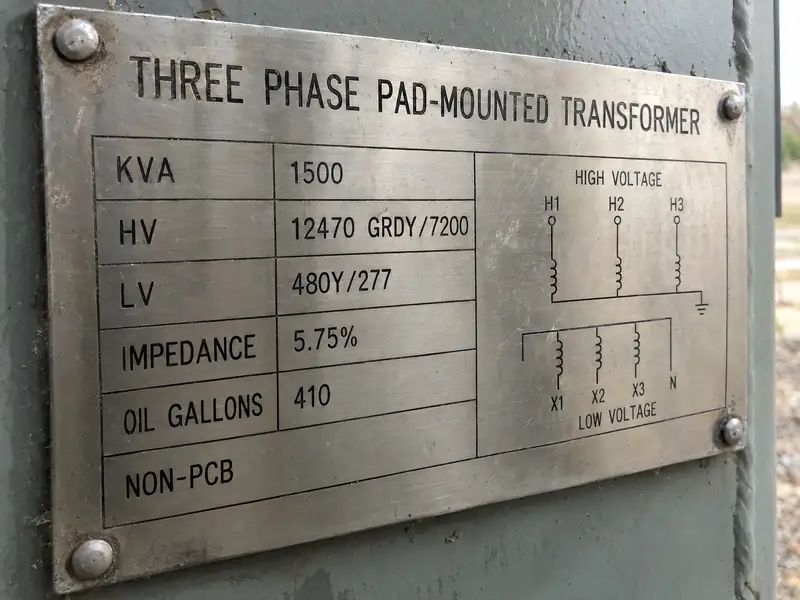
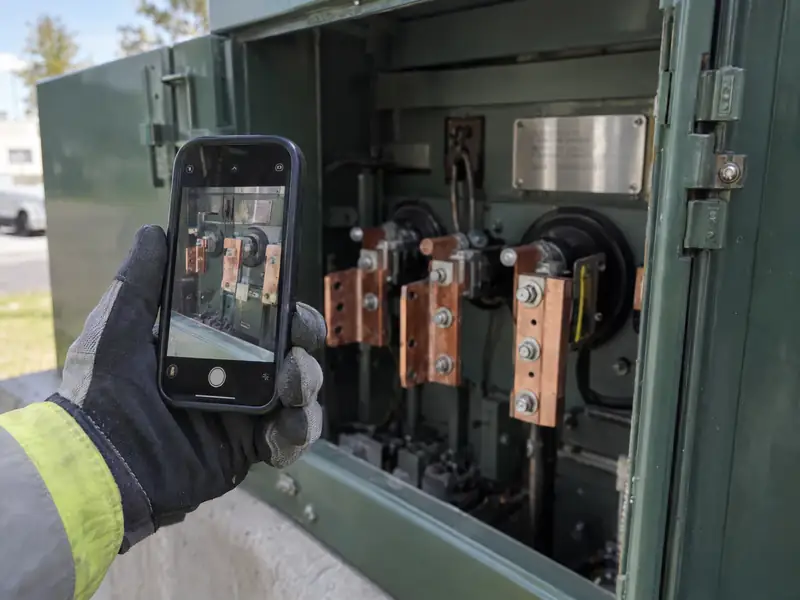
Start with a readable nameplate photograph taken from a safe position on equipment you are authorized to access. Our guide to reading a transformer nameplate explains the fields that make an evaluation more precise. Do not open compartments to obtain information.
For a three-phase 1000 kVA unit, the rating alone is insufficient. A buyer needs the exact HV and LV voltages, delta or grounded-wye connections, taps, impedance and configuration. A 480Y/277 V secondary serves different loads than 208Y/120 V, and neither is interchangeable without engineering review.
For station-class equipment, report every cooling-stage rating. A 12/16/20 MVA ONAN/ONAF/ONAF nameplate describes different capacities under different cooling conditions, not simply one 20 MVA rating. Fans, radiators and associated equipment therefore matter to the review.
- Manufacturer, serial number, manufacture year and 60 Hz frequency
- kVA or MVA rating, phase and all cooling stages
- Primary and secondary voltages, connections and tap positions
- Impedance, BIL, cooling class and temperature rise
- Fluid type, gallons, listed weights and winding material
- Switches, fuses, gauges, fans and tap-changing equipment
03Voltage and Configuration Can Matter More Than Size
Common California applications can create a broader pool of potential users, but actual compatibility must be checked. Typical three-phase secondaries include 208Y/120 V and 480Y/277 V. A 600 V secondary is less common in California, which may narrow demand rather than eliminate it.
Primary-voltage needs also vary. PG&E documents 12 kV and nominal 21 kV distribution, while SCE documents 4 kV, 12 kV and 16 kV systems, among others. A utility's nominal system voltage is not a substitute for the transformer's actual nameplate voltage, connection, taps or insulation requirements.
Physical arrangement can be just as decisive. A pad-mounted transformer may have loop-feed or radial-feed provisions, different termination arrangements and application-specific accessories. See three-phase pad-mount transformer configurations for context. A unit substation or specialty transformer may need a more specific match with the buyer's equipment.
04Age, Condition and Test Records Tell Different Stories
Manufacture year provides context, not a complete condition assessment. An older, well-documented transformer may remain a resale candidate, while a newer unit with damaged bushings, leaks or missing components may require substantial work. Describe what is known, including service history, storage conditions and the reason it was removed.
A transformer removed during a capacity upgrade presents a different starting point from one removed after an electrical fault. Neither description proves present condition. Buyers need to distinguish reported operating history from evidence supported by dated test reports.
Factory reports, turns-ratio results, insulation-resistance records and appropriate oil tests can reduce uncertainty. Our transformer oil testing and DGA guide explains how fluid-condition information supports evaluation. No single test proves that every part of a transformer is healthy; results need qualified interpretation.
- Disclose known faults, overheating events and protective-device operations.
- Include existing reports with dates and matching serial numbers.
- Photograph visible rust, leaks, damaged bushings or missing accessories safely.
- Identify whether the unit was energized or is never-energized surplus.
New-Surplus Is Not the Same as Recently Removed
New-surplus means never energized, not simply clean or lightly used. Storage damage, incomplete accessories and missing records can still affect its suitability. Sellers with unused project leftovers can review selling new-surplus transformers and provide factory documentation, packaging details and storage history.
05Fluid Type and PCB Documentation Affect the Available Path
Identify whether the transformer contains mineral oil, natural ester such as FR3, silicone, or uses dry insulation. Fluid type and quantity affect application suitability and handling considerations. Do not infer the fluid from appearance, and do not drain or sample equipment yourself.
Under federal TSCA classifications, non-PCB means below 50 ppm; PCB-contaminated means 50 to below 500 ppm; and a PCB Transformer contains 500 ppm or more. Non-PCB does not mean zero PCBs. Depending on its age and fluid history, equipment with unknown status may require presumptive classification until testing or qualifying documentation establishes concentration.
California has stricter rules for PCB-containing oil. Health and Safety Code 25250.1 excludes oil containing 5 ppm or more PCBs from the state's used-oil category; this does not mean every transformer at 5 ppm is automatically hazardous waste. Correct management depends on testing, documentation and the material's status.
Provide existing PCB labels, laboratory reports and fluid records for review. Our California PCB transformer seller guide covers these distinctions. Sellers should rely on qualified environmental professionals for classification and handling decisions; this information is not legal advice.
06Resale Value Versus Scrap Value: What Changes the Evaluation?
Resale evaluates the transformer as useful equipment. Scrap evaluates recoverable materials alongside dismantling, handling and environmental obligations. A working unit should not automatically be valued as scrap, but a failed unit should not be represented as ready for service.
Copper versus aluminum windings can affect material recovery and buyer preferences, but neither material alone establishes resale value. Use nameplate information or manufacturer documentation when available. Total transformer weight also includes components that are not recoverable winding metal, including the tank, core, fluid and fittings.
If your unit has failed or cannot reasonably return to service, review scrap and failed transformer evaluation. Suitability still depends on condition, documentation and handling requirements; purchase is not guaranteed.
| Evaluation factor | Equipment resale | Scrap or recovery |
|---|---|---|
| Electrical specifications | Must fit a usable application | Less central to material recovery |
| Condition evidence | Supports confidence in reuse | Identifies damage and handling concerns |
| Winding material | One factor among many | Relevant to recoverable materials |
| Fluid and PCB records | Support suitability and handling review | Help determine proper management |
| Access and weight | Affect rigging and freight | Affect recovery logistics |
07Market Lead Times and Removal Costs Shape an Offer
Availability can make a documented used transformer attractive when a project cannot wait for new equipment. NREL reported in 2024 that distribution-transformer lead times reached up to about two years, roughly four times pre-2022 levels. That historical market context supports interest in usable inventory, but it is not a current lead-time promise or a guarantee of value.
Demand remains specification-specific. A readily available transformer still needs to meet the receiving project's electrical, installation and condition requirements. Brand helps verify specifications, but rating, configuration and condition generally matter more.
Location and access can change the transaction substantially. Loading a removed unit from an accessible storage area differs from removing a large substation transformer behind structures or inside a restricted facility. Weight, dimensions, lifting access and freight requirements belong in the evaluation.
Only the owner's qualified electrical contractor or serving utility should handle isolation and disconnection, including potential backfeed from solar, batteries or generators. Read transformer removal and pickup considerations before comparing offers. Written terms should identify who handles rigging, loading and freight rather than leaving those responsibilities assumed.
08Send Rocky the Information Needed for a Written Offer
To sell a transformer, send nameplate and overall photos, quantity, California location and an honest condition description. Include existing test reports and fluid or PCB records when available. For mixed lots, identify each unit separately so ratings and records do not get confused.
You must own the equipment or have authority to sell it. A utility-owned transformer on your property is not yours to sell. If ownership is unclear, establish it before requesting a transaction.
Call or text Rocky at (951) 403-5738, or request a transformer review and written offer. Rocky reviews the information and may ask about ownership, tests, site access or removal readiness. Any offer should state what is included, rigging and freight responsibilities, and payment terms and timing before pickup.
- Readable nameplate photos and safe exterior views
- Quantity, location and ownership or selling authority
- Known condition and reason for removal
- Available electrical tests, fluid records and PCB documentation
- Access restrictions, listed weight and pickup readiness
FAQHow Much Is My Used Transformer Worth? FAQ
Can I get an estimate without knowing every specification?
You can start with the information you have. A clear nameplate photo often supplies several missing fields at once, and overall photos help identify the equipment family. Missing ratings, condition details or fluid records may limit the evaluation or require follow-up. Do not guess at unreadable fields or access restricted compartments to complete the request.
Should I pay for testing before offering my transformer for sale?
Send existing records first and ask which missing information matters to the review. Additional testing may be useful, but its relevance depends on the equipment, reported condition and intended resale path. Qualified electrical or environmental professionals should determine appropriate testing and perform it safely. Do not assume that ordering more tests will necessarily increase the offer.
Does an obsolete or unusual voltage make my transformer worthless?
Not necessarily. An uncommon voltage can reduce the number of compatible projects, but industrial or specialty applications may still use that configuration. Exact taps, connections and insulation ratings matter. Do not advertise the transformer as convertible to another voltage unless manufacturer documentation or a qualified engineering assessment supports that claim.
Will selling several transformers together improve the offer?
Quantity can affect buyer interest and transportation planning, but a larger lot does not automatically make every unit more valuable. Matching units with clear records may be easier to evaluate than unrelated equipment with unknown condition. Provide an inventory with each unit's serial number, rating and condition, and identify any units that must be sold together.
Do newer DOE efficiency rules prevent me from selling an older transformer?
DOE distribution-transformer efficiency standards apply to manufacture; they do not make existing used or surplus units illegal to resell simply because a newer standard exists. Requirements applying to units manufactured from January 1, 2016, and updated levels for manufacture on or after April 23, 2029, should not be confused with a blanket resale ban. Buyers still need to assess project suitability.
What should I compare besides the amount in a written offer?
Compare what equipment and accessories are included, who pays for or arranges rigging and freight, payment timing, and any conditions attached to the offer. Clarify responsibilities for contractor work and environmental requirements where relevant. An offer that leaves removal obligations unclear is difficult to compare fairly with one that spells out those responsibilities.