01How to Read a Transformer Nameplate Without Losing Important Details
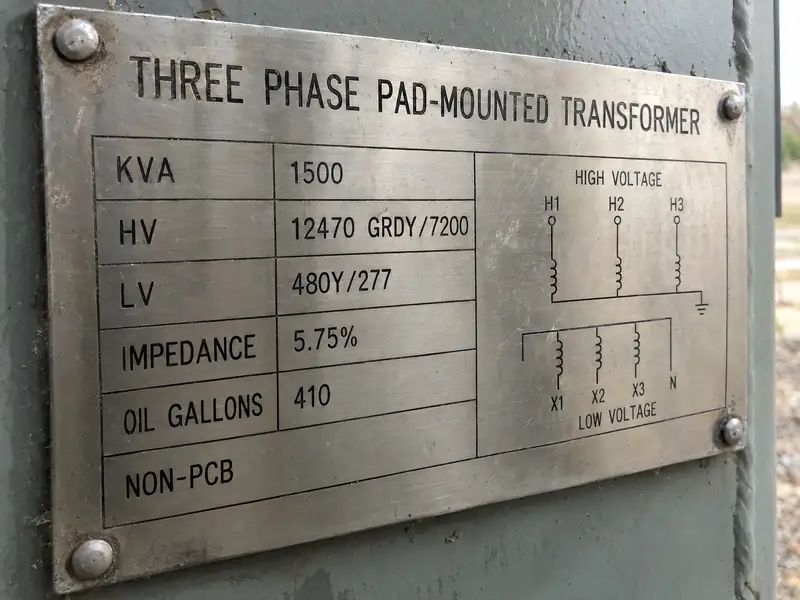
A nameplate describes the transformer’s design ratings, not its present condition. Read it as a connected set of specifications: capacity belongs with cooling class, voltage belongs with connection, and impedance belongs with its reference basis.
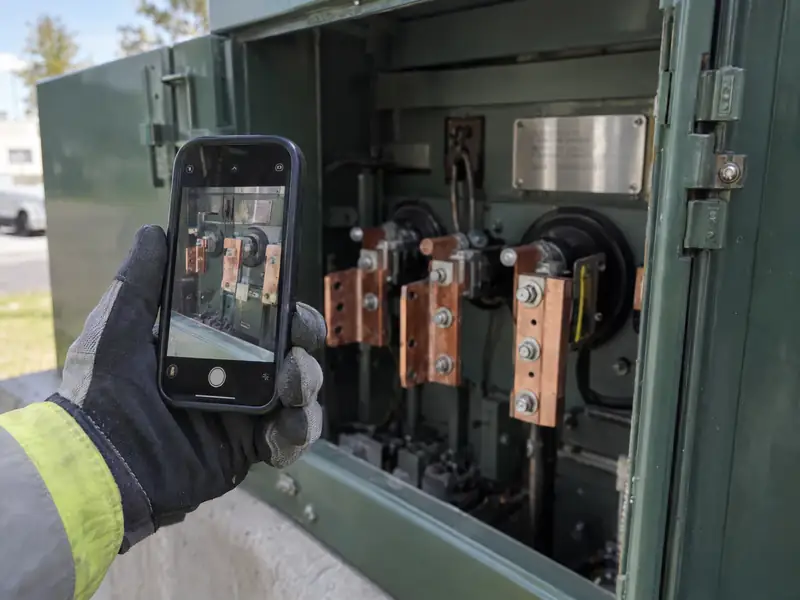
Take a full-plate photograph and readable close-ups from a safe position. Preserve slashes, decimal points, units and legacy wording when transcribing. Do not open compartments or approach exposed electrical parts to obtain a better picture; inaccessible information should come from existing records or qualified personnel.
This transformer guide explains what each field means and what to report. For the steps beyond identification, see the step-by-step transformer selling guide.
- Keep each plate photo matched to the correct unit.
- Photograph overall condition and safely visible accessory plates.
- Mark unreadable or undocumented fields as unknown.
- Do not substitute a nearby transformer’s specifications.
02Manufacturer, Serial Number and Manufacturing Date
Record the full manufacturer name, model, style or type, catalog number and factory location if shown. Older equipment may carry legacy names; retain that wording rather than replacing it with a presumed successor. These identifiers help establish construction and locate supporting documentation.
Copy the serial number along with shop, order or purchase-order numbers. Some low-voltage dry-type designs are not serialized, so a missing serial does not automatically mean the plate is false or damaged. In that case, preserve the exact catalog number and date code.
Distinguish original manufacture from a later repair, rebuild or retrofill date. Age supports equipment identification and environmental review, but it does not establish condition by itself. An older used transformer may have service records that explain changes not reflected on the original plate.
03kVA, MVA, Phase and Cooling-Stage Ratings
kVA measures apparent-power capacity; 1 MVA equals 1,000 kVA. It is not the same as delivered kilowatts, which depend on power factor. Report every listed rating rather than choosing the largest number.
For example, a 12/16/20 MVA ONAN/ONAF/ONAF plate identifies separate cooling-stage ratings. Reporting only 20 MVA conceals the self-cooled capacity and the cooling equipment required for higher output. For multi-winding designs, include each winding’s rating and any stated total.
Record single-phase or three-phase construction and the exact frequency. Although 60 Hz is common in the United States, neither phase nor frequency should be inferred from appearance. For a bank of single-phase units, distinguish individual-unit capacity from total bank capacity.
Compare capacity categories in the transformer kVA size guide, but use the actual plate as the specification source.
| Plate field | Meaning | What to preserve |
|---|---|---|
| kVA / MVA | Apparent-power capacity | Every rating and winding |
| Phase | Single- or three-phase design | Unit versus bank arrangement |
| Hz | Rated frequency | Exact printed frequency |
| Cooling stage | Cooling associated with output | Class, capacity and rise together |
04HV/LV Voltages, Neutral Notation and the Connection Diagram
HV means high voltage and LV means low voltage; these are not always interchangeable with primary and secondary in every application. Record exact voltages, rated currents, reconnectable options and tertiary windings. A slash may identify a grounded-wye relationship or another configuration, so do not interpret it without the accompanying diagram.
On a 20,780GrdY/12,000 V designation, 20,780 V is line-to-line and 12,000 V is line-to-neutral. That is different from a 12,000 V delta winding. California system descriptions such as nominal 21 kV do not replace the actual winding rating.
Likewise, 208Y/120 V, 480Y/277 V, 480 V delta and 240 V delta are different configurations. Preserve center-tap and neutral details. The transformer voltage guide provides context, but replacement compatibility requires the complete specification.
Photograph the connection and phasor diagrams clearly. Include H/X terminal labels, neutral terminals, polarity and angular displacement. US ANSI plates may use diagrams rather than IEC clock notation; delta-wye wording alone does not establish a vector group such as Dyn11.
05Tap Settings, Impedance and BIL
The tap table lists available voltage-ratio adjustments. Report the entire table, the documented selected setting, and whether the transformer has a de-energized tap changer or an on-load load tap changer, often called an LTC. A dual-voltage reconnecting switch is a separate feature and should also be identified.
Do not change taps or operate switches to verify a setting. If the position is not safely visible or documented, report it as unknown. Any verification or operation belongs to qualified personnel under appropriate procedures.
Percent impedance, or percent Z, affects fault-current calculations and paralleling compatibility. Include the winding pair, base kVA, reference temperature and principal tap when listed. Multi-winding transformers may have several impedance values rather than one universal figure.
BIL means basic impulse insulation level and is normally stated in kV. It describes impulse withstand, not operating voltage. Record HV, LV and tertiary BIL separately, along with equipment voltage class; a higher BIL number does not authorize operation at that voltage.
06Cooling Class, Temperature Rise and Special Application Ratings
Cooling codes describe how heat leaves the transformer. ONAN commonly denotes oil-natural, air-natural cooling; ONAF adds forced-air cooling. Legacy liquid-filled plates may use OA/FA, while dry-type plates may show AA/FA. Preserve other codes, including KNAN/KNAF, exactly as printed.
Temperature rise is an increase above specified ambient conditions, not a maximum room temperature. Liquid-filled plates may list 55°C or 65°C rise; dry-type plates may list 80°C, 115°C or 150°C. Associate each rise with its stated rating and cooling stage. Insulation-system class is a separate field.
Record special-duty descriptions such as generator step-up, inverter/BESS, drive isolation, network, K-factor or harmonic-mitigating duty. Include documented shielding, enclosure/NEMA/IP ratings, sound data, seismic documentation and UL/FM markings where applicable. Do not infer an approval from the equipment’s appearance.
For pad-mounted equipment, capture loop/radial feed, live-front/dead-front construction, interface amperage and voltage class, and protective devices. These details matter when evaluating three-phase pad-mount transformers, even when kVA and voltage match.
- Document fuse, breaker or VFI identification.
- Include surge arresters and switch arrangements.
- Match safely visible fan, pump and LTC plates to the unit.
- Identify accessories that are missing or excluded.
07Fluid Gallons, PCB Records and Documented Winding Material
Record the named insulating medium: mineral oil, natural or synthetic ester, FR3, silicone or another specified liquid. Include gallons or liters and distinguish original fill from a later retrofill. A dry-type transformer has no bulk insulating liquid; do not treat a blank fluid field as missing oil.
Photograph any PCB concentration, EPA or NO PCB label and attach laboratory records with the sample date and matching serial number. Under federal classifications, below 50 ppm is non-PCB, 50 to below 500 ppm is PCB-contaminated, and 500 ppm or more is a PCB Transformer. Non-PCB does not mean zero PCBs.
Unknown older equipment can trigger regulatory assumptions until testing or qualifying documentation establishes status. California has stricter rules for PCB-containing oil, and the proper management pathway depends on testing and documentation. Rely on qualified environmental professionals; this guide is not legal advice. See PCB documentation and California seller requirements.
Copper or aluminum winding material should come from an OEM plate, drawing or other reliable documentation, separately for each winding when available. Terminal metal and total weight do not prove winding material. Existing transformer oil testing and DGA reports can support condition review, but DGA is not a substitute for PCB testing.
08Weight Fields and the Photo Package to Send Rocky
Copy every listed weight and its units: total, fluid, tank-and-fittings, core-and-coil, untanking and shipping weights. Operating weight may differ from transport weight, especially for a large substation or station-class transformer. Total weight is not copper weight, and a nameplate does not replace dimensions or a lifting drawing.
To sell a transformer, send California Transformer Buyer the readable plate photos, overall photos, quantity, California location and known condition. Include test reports, service history and fluid records when available. You must own the equipment or have authority to sell it; utility-owned equipment cannot be sold simply because it sits on your property.
Call or text Rocky at (951) 403-5738, or request a transformer offer review. Reviewing your transformer costs nothing and there is no obligation. Any written offer states what is included, who handles rigging and freight, and payment terms before pickup.
- Identify leaks, rust, damaged bushings and missing parts.
- State used, removed or never-energized new-surplus status.
- Provide site-access information without moving equipment.
- Leave isolation and disconnection to the qualified contractor or serving utility.
FAQHow to Read a Transformer Nameplate FAQ
Can I request an offer if the nameplate is missing or unreadable?
Yes. Send safely obtained overall photographs and explain which identification is unavailable. Factory drawings, purchase documents, test reports or a matching equipment schedule may help establish specifications. Do not guess missing voltage or capacity from enclosure size. Rocky may need additional documentation before evaluating the unit, and incomplete identification can limit the available resale options.
Does a nameplate prove that a transformer is ready to energize?
No. The plate records design information, not current insulation condition, mechanical integrity or service readiness. Leaks, damaged bushings, storage exposure and missing accessories can change the assessment. Appropriate inspection and testing by qualified personnel are separate from reading the plate. A buyer also needs to know whether supplied reports apply to that exact unit and its current condition.
Should I send separate information for identical transformers in a lot?
Yes. Provide each unit’s serial or other identifier, quantity and condition, even when the units appear identical. Similar enclosures can contain different voltages, impedances, winding materials or manufacturing dates. A simple inventory that connects each plate photograph to its corresponding overall photograph helps prevent mismatches and makes differences within a mixed lot easier to evaluate.
Does an older manufacturing date make a transformer illegal to resell?
Not by itself. DOE distribution-transformer efficiency standards apply to manufacture; they do not make existing used or surplus units illegal to resell simply because newer standards exist. Age still matters for identification, service history and PCB-status review. Eligibility for a particular installation is a separate technical and regulatory question, requiring review of the equipment and proposed application.
What if the nameplate and a recent test report show different information?
Send both documents and identify the discrepancy rather than choosing whichever specification seems more favorable. Confirm that the report’s serial number matches the transformer. A repair, retrofill, changed tap position or documentation error may explain a difference, but the explanation should be supported by records. Until resolved, report the conflicting information clearly and avoid claiming verified compatibility.