01Transformer kVA and Amps: How the Two Ratings Relate
A transformer's kVA rating describes apparent-power capacity, not a fixed number of amps at every voltage. The same unit has different rated currents on its primary and secondary because those windings operate at different voltages. Lower voltage means higher current for the same kVA.
Amps calculated from the nameplate are rated full-load current, not proof of what the transformer currently carries. Actual current changes with the connected load. For a seller, this distinction prevents a common mistake: describing a transformer by a breaker rating or a meter reading instead of its nameplate capacity.
This transformer guide provides calculation methods, not an installation design. Before you sell a transformer, identify its phase and both winding voltages; the guide to transformer voltages helps explain common configurations.
- kVA means kilovolt-amperes: apparent power.
- kW means kilowatts: real power.
- Power factor relates real power to apparent power.
- 1 MVA equals 1,000 kVA.
02Single-Phase kVA-to-Amps Formula and a 50 kVA Example
For a single-phase transformer, use I = kVA × 1,000 ÷ V. Here, I is current in amps and V is the voltage across the winding being evaluated. To calculate kVA from known voltage and current, reverse the formula: kVA = V × I ÷ 1,000.
A 50 kVA transformer with a 240 V secondary has a rated secondary current of 50 × 1,000 ÷ 240 = 208.3 amps. If its primary is rated 7,200 V, the calculated primary current is 50 × 1,000 ÷ 7,200 = 6.94 amps. These calculations use nominal ratings and do not model losses.
For a 120/240 V center-tapped secondary, use 240 V when calculating the full winding's rated current. Do not divide the entire 50 kVA by 120 V and treat that result as the available current on each leg. Unequal 120 V loads require separate consideration of winding loading and the manufacturer's limits.
- Amps: kVA × 1,000 ÷ volts.
- kVA: volts × amps ÷ 1,000.
- Use the voltage for the winding or circuit being evaluated.
03Three-Phase Calculations Use Line-to-Line Voltage
For a balanced three-phase load, use I = kVA × 1,000 ÷ (√3 × VLL), where √3 is approximately 1.732 and VLL is line-to-line voltage. The result is line current. The reverse calculation is kVA = 1.732 × VLL × I ÷ 1,000.
A 1,000 kVA transformer rated 480Y/277 V has a calculated secondary line current of 1,000,000 ÷ (1.732 × 480), or about 1,203 amps. Use 480 V, not 277 V, in this three-phase formula. At a 12,470 V primary, its corresponding calculated line current is about 46.3 amps.
The table shows how secondary voltage changes current without changing transformer capacity. These are rounded, balanced-load calculations—not recommended breaker sizes, conductor ampacities or permissible overloads. For equipment identification, see three-phase pad-mount transformer configurations.
| Transformer rating | At 208 V | At 480 V |
|---|---|---|
| 75 kVA | 208 A | 90 A |
| 150 kVA | 416 A | 180 A |
| 500 kVA | 1,388 A | 601 A |
| 1,000 kVA | 2,776 A | 1,203 A |
04Read the Nameplate Before Choosing a Calculator Input
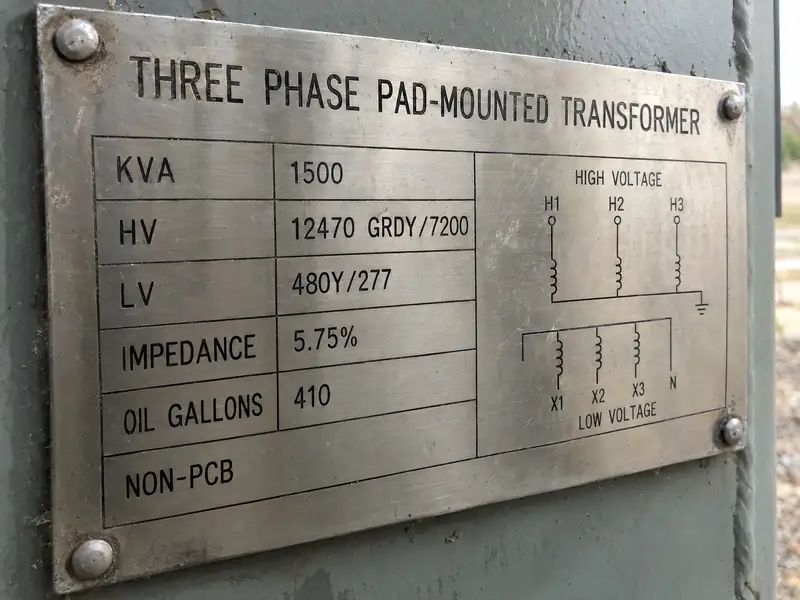
Start with the manufacturer's nameplate, not the enclosure size or nearby switchgear label. Record kVA, phase, frequency, primary voltage, secondary voltage and the connection diagram. Include all stated cooling-stage ratings, taps and temperature-rise information.
On a 208Y/120 V nameplate, 208 V is line-to-line and 120 V is line-to-neutral. Likewise, 480Y/277 V identifies 480 V between lines and 277 V to neutral. A grounded-wye primary marking such as 12,470GrdY/7,200 V also contains both voltage references.
California has multiple utility voltage systems, so a location alone cannot establish the rating. SCE documents 4 kV, 12 kV and 16 kV distribution, while PG&E's Rule 2 includes 12,000 V and 20,780 V primary configurations. Always use the actual nameplate and applicable connection—not a regional assumption.
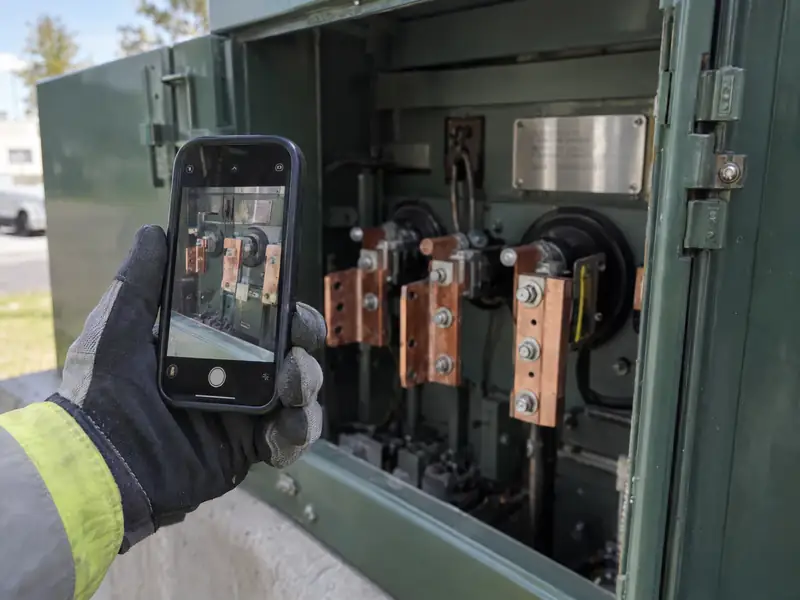
Take photos only from a safe position on equipment you are authorized to access. Do not open compartments to obtain a hidden plate. Before offering equipment installed on your property, use the transformer ownership checklist to confirm your authority to sell.
- Capture the complete plate, including its connection diagram.
- Include manufacturer, serial number and year.
- Record impedance, BIL and cooling class.
- Identify fluid type or dry-type insulation.
- Include existing test reports when available.
05Sizing Basics: Load kVA Is Not the Entire Design
A preliminary load calculation starts with apparent power. For a balanced three-phase 480 V load drawing 400 amps, kVA = 1.732 × 480 × 400 ÷ 1,000 = 332.5 kVA. That number describes the stated load condition; it does not, by itself, select the final transformer.
When starting with kW, divide by power factor to estimate kVA under the stated operating conditions. A 200 kW load at 0.80 power factor requires 250 kVA. Power factor is not transformer efficiency, and neither should be assumed from the other.
A qualified electrical designer must also consider continuous loading, coincident demand, motor starting, voltage drop, harmonics, ambient conditions, ventilation, expected growth and applicable codes. There is no universal percentage that safely covers every installation. A lightly loaded spare may still be unsuitable because its voltage or connection is wrong.
- Motor starting can create temporary current well above running current.
- Nonlinear loads can add harmonic heating.
- Unbalanced loads require checking individual phase loading.
- Protective-device and conductor selection require separate calculations.
Do Not Convert Nameplate Amps Directly into a Breaker Recommendation
Transformer protection depends on more than full-load current. Inrush, primary and secondary protection arrangements, conductor ratings and applicable code provisions affect the design. Leave equipment selection and protection coordination to qualified professionals.
06Preferred kVA Sizes and Cooling-Stage Ratings
Recognizable rating sizes help identify equipment, but a size list is not a rule that excludes other ratings. IEEE C57.12.00-2015, section 5.4.2/Table 2, lists preferred continuous ratings for its 65°C average winding-rise basis. The examples below are selections from that verified edition, not the complete list or a claim about the full current-edition table.
A 3,000 kVA transformer is a common commercial/catalog size even though it is not in that verified preferred series. Likewise, 667 kVA appears in DOE liquid-filled efficiency tables, not this verified IEEE list. A different rating is a reason to check documentation, not declare the equipment invalid.
Large station-class units may have multiple ratings, such as 12/16/20 MVA ONAN/ONAF/ONAF. Those correspond to specified cooling stages; the highest rating should not be treated as available without its required cooling equipment and operating conditions. Include every stage when submitting a substation transformer for review.
| Phase | Selected ratings in kVA |
|---|---|
| Single-phase | 5, 10, 15, 25, 37.5, 50 |
| Single-phase | 75, 100, 167, 250, 333, 500 |
| Three-phase | 15, 30, 45, 75, 112.5, 150 |
| Three-phase | 225, 300, 500, 750, 1,000, 1,500 |
| Three-phase | 2,000, 2,500, 3,750, 5,000, 7,500, 10,000 |
07Why Equal kVA Ratings Do Not Mean Equal Resale Fit
Two 500 kVA transformers can serve very different applications. A 12,470 V-to-480Y/277 V padmount unit is not interchangeable with a 480 V-to-208Y/120 V dry-type transformer. Phase, winding connection, impedance, BIL, enclosure and cooling all matter alongside capacity.
California Transformer Buyer also considers condition, winding material if documented, accessories, test reports, fluid records and site access. A used transformer should be identified as previously energized; never-energized equipment belongs in a different condition category. The new, used and rebuilt transformer guide explains these distinctions.
A correct amps calculation cannot establish insulation condition, fluid condition or reuse suitability. Provide existing test and PCB documentation rather than guessing from age or appearance. Environmental determinations should rely on testing, documentation and qualified environmental professionals; this guide is not legal advice.
08Send Rocky the Rating Details for a California Offer
To sell a transformer in California, call or text Rocky at (951) 403-5738. Send safely obtained nameplate and overall photos, quantity, location, condition and whether the unit remains installed. Include your calculations if helpful, but the actual plate is the essential reference.
Use the transformer submission form to provide the same information online. Rocky reviews the equipment and may ask for ownership records, test reports, fluid documentation or access details. Reviewing your transformer costs nothing and there is no obligation.
A written offer states what is included, who handles loading or rigging and freight, and payment terms and timing. The transformer buying process explains those steps. Isolation and disconnection belong to the owner's qualified electrical contractor or serving utility, not the seller acting on calculator results.
FAQTransformer kVA and Amps: How to Size and Read Ratings FAQ
Can I calculate a transformer's kVA from its secondary breaker?
Not reliably. A breaker identifies a protective-device rating, not necessarily the transformer's capacity or actual load. Its selection may reflect the protection arrangement and other design requirements. Use the transformer nameplate to establish kVA. If that plate is missing, manufacturer records and existing project documentation may help verify the unit.
Does a 1,000 kVA transformer supply 1,000 kW?
Only at unity power factor does 1,000 kVA correspond to 1,000 kW at the same measurement point. At 0.90 power factor, 1,000 kVA corresponds to 900 kW. That relationship does not account for every operating limitation or transformer loss. For sizing, use the actual load characteristics rather than assuming kVA and kW are interchangeable.
How do I calculate capacity for a bank of three single-phase transformers?
For a conventional balanced three-unit bank of identical transformers connected appropriately, total bank capacity is generally the sum of the three unit ratings. Three 25 kVA units therefore form a 75 kVA bank. Open-delta arrangements and unequal units require different evaluation. Send each unit's nameplate and the documented bank connection rather than assuming all arrangements have the same capacity.
Do voltage taps change the amps calculation?
Taps change the winding ratio and must be interpreted using the manufacturer's rating information. A nominal-voltage calculation is useful for reference, but it does not establish every permitted operating condition at every tap. Provide the full tap schedule and existing documentation. Do not open equipment or adjust taps to verify specifications for a sale.
Does low measured current prove a used transformer is in good condition?
No. Low current may simply mean that little load was connected when the measurement was taken. It does not establish insulation health, winding condition, fluid quality or performance under load. Existing qualified test reports are more useful for condition review. Sellers should not arrange informal energized measurements merely to support a sale.
Can an older transformer still be sold if its efficiency differs from newer units?
DOE efficiency standards apply to manufacture; they do not automatically make existing used or surplus transformers illegal to resell. Reuse suitability still depends on specifications, condition and the intended application. The DOE efficiency guide for used transformers explains the manufacturing dates and standards relevant to a seller's review.