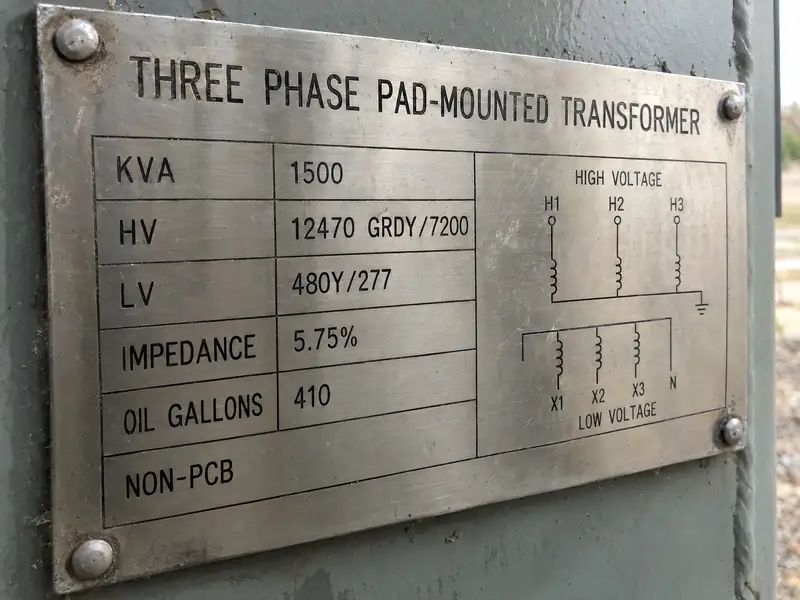
014160 V (4.16 kV) Transformer Nameplate Meanings
A 4160 V (4.16 kV) transformer may be used as a plant medium-voltage secondary or as a legacy utility primary. The number alone does not identify the winding connection, phase, or whether the voltage is specified line-to-line or line-to-neutral. A buyer needs the complete nameplate and connection diagram to understand what the unit can serve.
For a 4160Y/2400 system, 4160 V is the wye line-to-line value and 2400 V is the line-to-neutral value. A 2400 V winding listed on its own could instead be a primary or plant-bus rating. Keep those contexts separate when describing a unit. For other fields to photograph, see this guide to transformer nameplate details.
| Nameplate notation | What it indicates | What to verify |
|---|---|---|
| 4160 V | 4.16 kV winding rating | Connection and phase |
| 4160Y/2400 V | Wye line and neutral values | System and winding arrangement |
| 2400 V | Possible primary or MV winding | Whether it is line-to-line or system context |
| 4.8 kV | A distinct voltage rating | Do not relabel as 4.16 kV |
02Where 4.16 kV Equipment Fits in California
In industrial facilities, 4.16 kV is used for medium-voltage motors and plant distribution. A 4160-to-480 V transformer can step down a plant medium-voltage supply for lower-voltage equipment, but the actual winding arrangement and load requirements must match. For secondary-side context, compare the rating with common 480Y/277 V transformer configurations.
Some California utility documentation also supports this rating, but it is not a statewide default. PG&E Rule 2 lists 4,160 V among primary configurations, and 4.16 kV primary-metered service is documented in LADWP’s service area. Do not infer that a particular property receives 4.16 kV from its location alone; confirm the serving system with the utility or facility records.
California distribution systems use multiple voltage classes, and a similar-looking rating is not interchangeable. The broader transformer voltage guide distinguishes 4.16 kV from 4.8 kV, 12 kV, 16 kV and other classes.
03Transformer Types and Ratings That May Carry 4.16 kV
The rating can appear on different equipment, not only on a utility-style distribution transformer. Industrial applications may use liquid-filled units, dry-type transformers or unit substations serving a motor bus or facility switchgear. The enclosure, insulation and intended installation affect both reuse and handling; a medium-voltage dry-type transformer has different construction from an oil-filled unit.
Three-phase kVA ratings commonly found across transformer families include 75, 112.5, 150, 225, 300, 500, 750, 1,000, 1,500 and 2,000 kVA, with larger ratings extending into MVA. These are common industry ratings, not a claim that every size is available in 4.16 kV. A 4.16 kV unit may be a pad-mounted design, but many plant units are indoor dry type or part of a unit substation. See examples of three-phase pad-mount transformers and common transformer kVA sizes.
04Check Compatibility Before Reuse
A matching voltage is only the first screening point. A potential buyer needs to compare phase, primary and secondary ratings, connection (such as delta or grounded wye), taps, frequency, impedance, BIL, cooling class and kVA or MVA rating with the intended system. The transformer must also suit the load, protection scheme and installation requirements, which should be evaluated by qualified electrical professionals.
Condition and records matter too. Age, winding material, fluid type, leaks, damaged bushings, missing accessories and available test reports all help establish what the equipment is and whether reuse is practical. Factory reports and later electrical or oil test documentation can support review, but do not substitute for a compatibility assessment by the buyer and their qualified professionals.
A 4.16 kV unit should not be assumed to substitute for a 4.8 kV, 2.4 kV, 12 kV or other class simply because a value looks close. Share the complete nameplate and connection diagram so the ratings can be reviewed in context.
05What Affects Buyer Interest in a 4160 V Unit
Resale interest depends on the unit’s configuration, condition and documentation, as well as whether its rating fits a buyer’s application. A common kVA rating, usable accessories and a clearly documented 4160-to-480 V arrangement may help a buyer assess a unit. There is no universal value based on voltage alone, and an offer is specific to the equipment and transaction terms.
California Transformer Buyer reviews used, pulled, surplus and new-surplus equipment from sellers in California. If you are comparing options for a used transformer buyer or handling inventory left from a project, include whether the unit was energized, whether it is crated or on skids, and what test or maintenance records are available.
06What to Send for a 4160 V Transformer Review
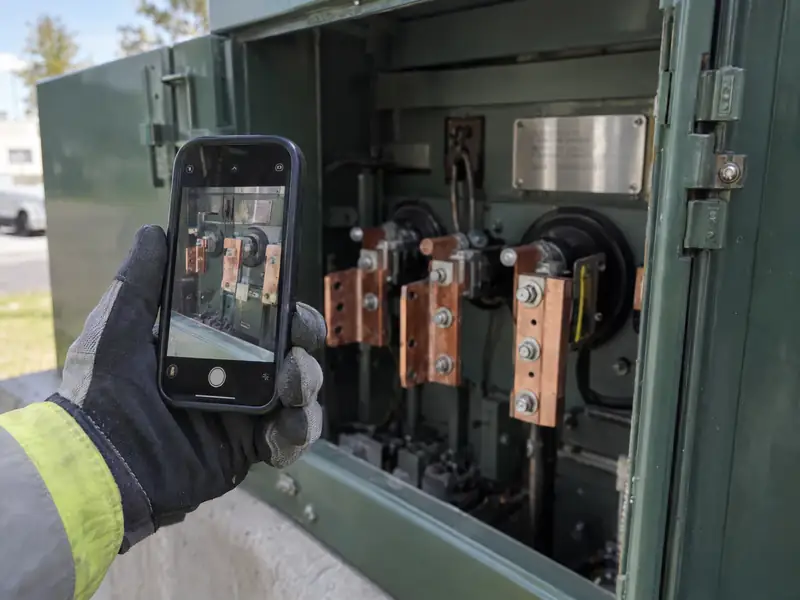
Start with clear photos taken from a safe position of equipment you are authorized to access. Include the full nameplate, an overall view of the transformer and visible accessories. Do not open compartments or approach equipment that has not been made safe by qualified personnel.
Along with the photos, provide the number of units, site location in California, condition and whether the equipment is used or new-surplus. If available, include test reports, fluid and PCB records, ownership or sale authority information, and details about access. Those records help clarify the unit without asking you to inspect or handle it.
- Manufacturer, serial number and year, if shown
- kVA or MVA, phase, voltage and connection
- Cooling class, taps, impedance and BIL, if shown
- Fluid type, quantity and PCB documentation, if applicable
- Quantity, location, condition and available test reports
07How to Request an Offer and Confirm Terms
Call or text Rocky at (951) 403-5738, or use the transformer offer request form. Send the photos and details above, then Rocky reviews the information and may ask follow-up questions about testing, fluid or PCB records, ownership and site access.
If the unit is of interest, you receive a written offer that states what is included, who handles loading or rigging and freight, and the payment terms and timing. Confirm those terms in writing before pickup. Equipment must be owned by the seller or the seller must have authority to sell it; equipment owned by a utility cannot be sold by a property owner.
FAQ4160 V (4.16 kV) Transformer FAQ
Is a 4160 V transformer the same as a 4.8 kV transformer?
No. A 4160 V (4.16 kV) rating and a 4.8 kV rating are distinct, and a buyer should not treat them as interchangeable. The nameplate and system documentation determine the actual winding voltage and connection. Send photographs of the complete nameplate rather than describing a unit from its appearance or from a nearby system’s nominal voltage.
Can a 4160 V transformer be used to supply 480 V equipment?
It can be configured to step from 4160 V to 480 V when its nameplate ratings and winding arrangement specify that transformation. The phase, connection, capacity, taps and electrical system must also be suitable for the intended application. A qualified electrical professional should assess whether a particular unit can be reused in a specific installation.
Does the 4160Y/2400 V marking mean the transformer has two separate ratings?
The notation generally gives the line-to-line and line-to-neutral values of a wye system: 4160 V line-to-line and 2400 V line-to-neutral. It should be read with the nameplate diagram and winding details. A standalone 2400 V rating can have a different role, so do not assume it describes the same system arrangement.
Will California Transformer Buyer review a single transformer?
Yes. California Transformer Buyer reviews single units as well as larger quantities and mixed lots from sellers located in California. A review does not guarantee that a unit will be purchased. Provide the nameplate, overall photos, location and condition so Rocky can assess the specific equipment and ask for any details needed.
What if I cannot find test reports or PCB records?
Send the records you do have and note what is missing; do not guess or label unknown fluid status as confirmed. Test results and documentation should be reviewed with qualified environmental professionals, and applicable requirements depend on the equipment and its records. PCB and used-oil rules can be specific, so this information is not legal advice.
Do I need to disconnect the transformer before requesting an offer?
No. You can request a review using photographs taken safely from a position you are authorized to access. Do not de-energize, disconnect, open, drain, sample or move the equipment yourself. The owner’s qualified electrical contractor or serving utility must handle electrical isolation and related work.