01What a 480Y/277 V Transformer Supplies
A 480Y/277 V transformer has a three-phase secondary connected in grounded wye. The 480 V value is measured between phases; 277 V is measured from a phase to the neutral. That combination supports equipment using 480 V three-phase power as well as 277 V lighting and other phase-to-neutral loads.
At a facility, 480Y/277 V is a common California distribution voltage for commercial and industrial electrical systems. It is a secondary voltage, not a statement of the utility's primary distribution voltage. The primary winding, service arrangement and connection must be confirmed from the actual transformer nameplate and the facility's electrical requirements.
02How 480Y/277 V Appears on a Transformer Nameplate
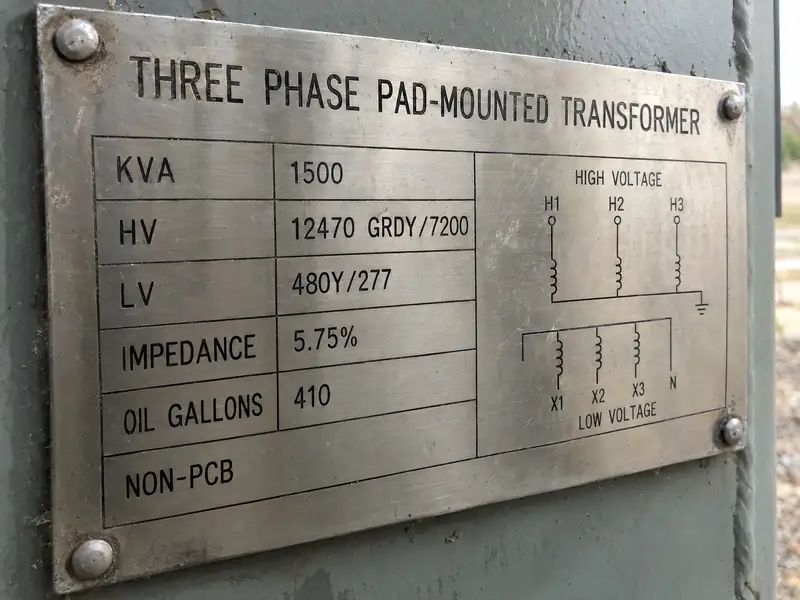
Look for the low-voltage or secondary entry, often shown as 480Y/277 V, 480Y/277, or as separate phase-to-phase and phase-to-neutral values. The diagram or connection field should identify the secondary as wye, grounded wye, or GrdY. A neutral terminal is part of the configuration that makes 277 V available.
Do not treat a plain 480 V label as equivalent. A 480 V delta secondary is typically three-wire and may be ungrounded or corner-grounded; it does not provide a 277 V neutral unless a different configuration is specifically identified. For a full field-by-field checklist, see how to read a transformer nameplate.
- Check phase, frequency and secondary connection.
- Record primary voltage and tap positions.
- Note kVA rating, impedance and temperature rise.
- Photograph the connection or vector diagram.
03Transformer Types and kVA Ratings That May Have This Secondary
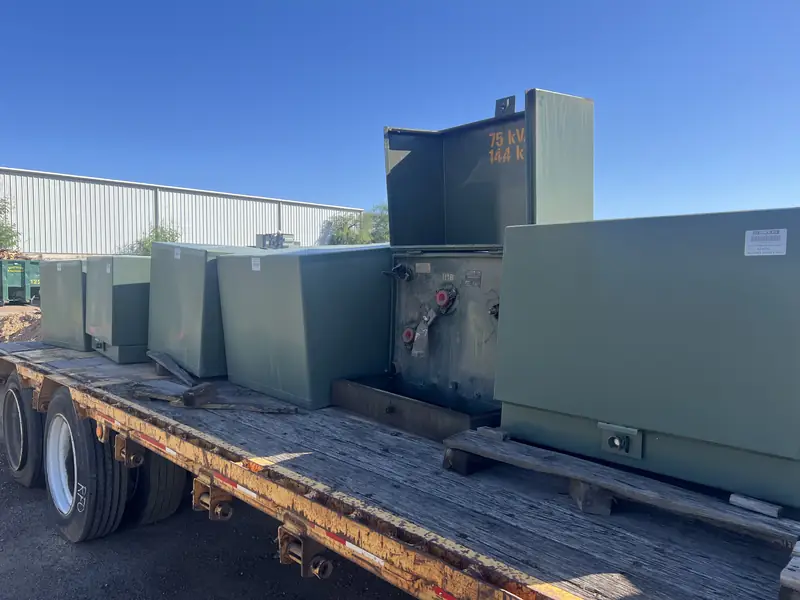
480Y/277 V secondaries appear on three-phase dry-type transformers, unit substations and three-phase liquid-filled pad-mount units. Indoor commercial and industrial installations often use dry-type equipment; outdoor installations may use pad-mounted equipment. Configuration depends on the application, primary voltage and project design, so the voltage alone does not identify the transformer type.
Standard three-phase ratings include 75, 112.5, 150, 225, 300, 500, 750, 1,000, 1,500, 2,000 and 2,500 kVA, with larger ratings available. These are examples of standard three-phase sizes, not a guarantee that every rating is made with a 480Y/277 V secondary. See standard transformer kVA sizes, dry-type transformer configurations and three-phase pad-mount units for related equipment details.
04Where 480Y/277 V Equipment Is Used in California
Facilities use this voltage where substantial three-phase loads and 277 V lighting are both useful. Common settings include warehouses, manufacturing and processing sites, large commercial buildings, data centers, and solar or energy-storage projects. Loads can include motors, HVAC equipment, distribution panels, lighting circuits and power-conversion equipment, depending on the facility design.
A 480Y/277 V transformer may serve a building from a higher-voltage source, or it may be part of a larger facility distribution arrangement. Do not assume the serving utility supplies a particular primary voltage based only on the property's location. California utilities use different distribution configurations, and the actual service and transformer nameplate should guide any compatibility review.
05What Buyers Check Before Reusing a 480Y/277 V Transformer
Matching the secondary voltage is only the first check. A potential reuse needs a suitable primary voltage and tap range, phase, frequency, kVA capacity, winding connection, impedance, insulation and installation arrangement. Buyers also compare the transformer with the load, protection, grounding and switchgear requirements of the intended project. A 208Y/120 V unit, for example, has a different secondary and is not a substitute simply because it is also three-phase.
Condition and documentation also matter. Review the year, manufacturer, test reports, signs of leaks or damage, included accessories and, for liquid-filled equipment, fluid type and available PCB records. A dry-type transformer has different condition and insulation details from an oil-filled unit. If the nameplate shows a medium-voltage primary, compare that exact rating with the project supply; a 12 kV or 12.47 kV transformer primary is not interchangeable with every utility circuit.
- Confirm all primary and secondary ratings.
- Compare taps, connection and impedance.
- Share available factory or field test reports.
- Identify missing parts and visible condition issues.
06What to Send for a 480Y/277 V Transformer Review
Send clear photos of the nameplate and the full transformer from a safe position, along with the number of units, California location and known condition. Include any available test reports, fluid or PCB records, ownership information and details about accessories or missing components. For a new-surplus unit, say whether it has never been energized and whether it remains crated or on skids.
You do not need to open, disconnect, drain, sample or move the equipment to request a review. Only take photos of equipment you are authorized to access, and leave electrical isolation and handling to the owner's qualified electrical contractor or serving utility. Start through the transformer selling process or the contact form for an offer request, or call or text Rocky at (951) 403-5738.
07Written Offers, Ownership and Pickup Planning
California Transformer Buyer reviews used, pulled, surplus and new-surplus transformers located in California, from single units to mixed lots. After reviewing the equipment details, Rocky may ask follow-up questions about testing, site access, ownership or environmental records. Reviewing a transformer costs nothing and creates no obligation.
If the unit is suitable for an offer, the written terms state the price, what is included, who handles loading or rigging and freight, and payment terms and timing. Pickup is scheduled according to those terms. The seller must own the transformer or have authority to sell it; utility-owned equipment at a property cannot be sold by the property owner.
FAQ480Y/277 V Transformer FAQ
Can a 480 V delta transformer supply 277 V loads?
Not by default. A typical 480 V delta secondary is three-wire and does not provide the grounded-wye neutral used to obtain 277 V phase-to-neutral power. Some configurations may have a different connection, so check the nameplate and connection diagram rather than relying on a general 480 V label. If 277 V loads are part of the intended use, have a qualified electrical professional verify the configuration.
Does the 480Y/277 V label tell me the transformer's primary voltage?
No. The 480Y/277 V designation describes the secondary output. A transformer may have different primary ratings and tap arrangements while sharing that secondary voltage. For a buyer review, send a readable photo of the complete nameplate, including the high-voltage side, taps and connection information. For reuse, the primary must suit the intended source and installation.
Will California Transformer Buyer review a single 480Y/277 V transformer?
Yes, a seller can submit one unit for review, as well as multiple units or a mixed lot. Whether a particular transformer is suitable for an offer depends on its rating, type, condition, documentation, location and other project and handling details. Send its nameplate and overall photos with the quantity and location so Rocky can assess the specific equipment.
What if the transformer has no recent test report?
Send the information you have and identify which reports are unavailable. A missing report does not establish that a transformer is unusable, but it can affect how a buyer evaluates its condition and potential reuse. Do not conduct testing yourself or access energized equipment for photos. Testing and any electrical work should be handled by qualified personnel.
Can I sell a transformer that is still connected at my facility?
You can ask for a review while the transformer remains installed, but do not disconnect or move it yourself. The owner’s qualified electrical contractor or the serving utility must handle isolation and disconnection. Tell us whether the unit is installed, and share photos only from a safe position and where you are authorized to take them. Pickup arrangements are addressed in the written offer.
What should I do if the transformer has unknown PCB status?
Share any labels, historical records and available test documentation, and state clearly that the status is unknown. Do not assume that an oil label proves zero PCBs or decide on a disposal or reuse pathway from a guess. Sellers should rely on testing, documentation and qualified environmental professionals; PCB and used-oil requirements depend on the equipment and its records. This information is not legal advice.