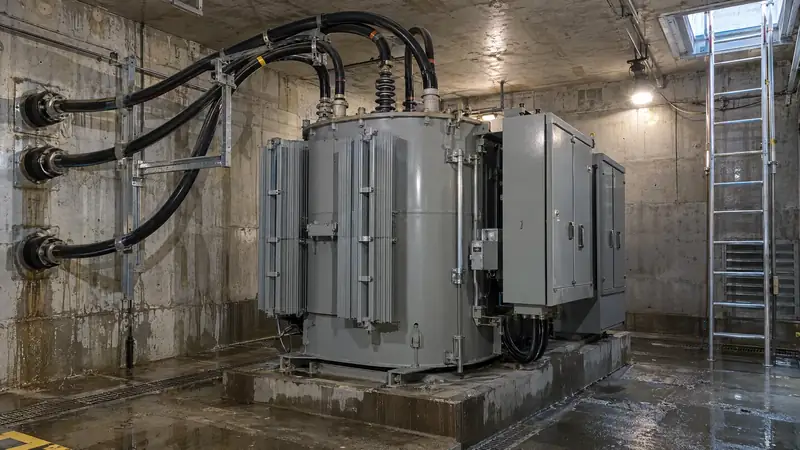
01How to Identify a Submersible Transformer
A submersible transformer buyer needs more than a photo of a transformer sitting below grade. A vault transformer is built for underground installation, while a truly submersible design has specified sealing and corrosion resistance for immersion. The nameplate or manufacturer documentation must establish that rating; a vault location by itself does not.
Look from a safe, authorized position for a compact, liquid-filled tank, corrosion-resistant construction, and cable terminations suited to the installation. These visual cues help identify the equipment, but they do not replace the nameplate. Truly submersible models should have an immersion or sealing specification. Ordinary ventilation openings into the liquid tank are not a feature of the expected design.
Photograph the full unit and the nameplate without entering a restricted area or opening any compartment. Useful nameplate details include manufacturer, serial number, year, kVA, phase, primary and secondary voltages, connection, impedance, cooling class, fluid type, and weight. A clear image of the rating and any submersible designation can help distinguish it from other underground units.
- Record whether the unit is single- or three-phase.
- Note visible corrosion, leakage, damaged bushings or missing parts.
- Include any available immersion, sealing or manufacturer documents.
02Where Vault Transformers Serve California Loads
Submersible and vault transformers step down distribution voltage for underground urban service. Utilities use them in below-grade vaults, including locations that can be exposed to flooding, and for both network and non-network distribution. In dense areas, underground equipment can supply buildings and interconnected distribution networks where overhead pole equipment is not the arrangement.
California’s underground utility equipment may be owned by a utility, municipality, building owner or another authorized asset owner. A property owner cannot sell utility-owned equipment just because it is located on the property. Before requesting an offer, confirm that you own the transformer or have written authority to sell it.
Utilities and public agencies often manage specialized underground assets as part of broader distribution systems. See our information for utilities and municipal utility sellers and compare a vault unit with network transformers, which may have interfaces for network protectors.
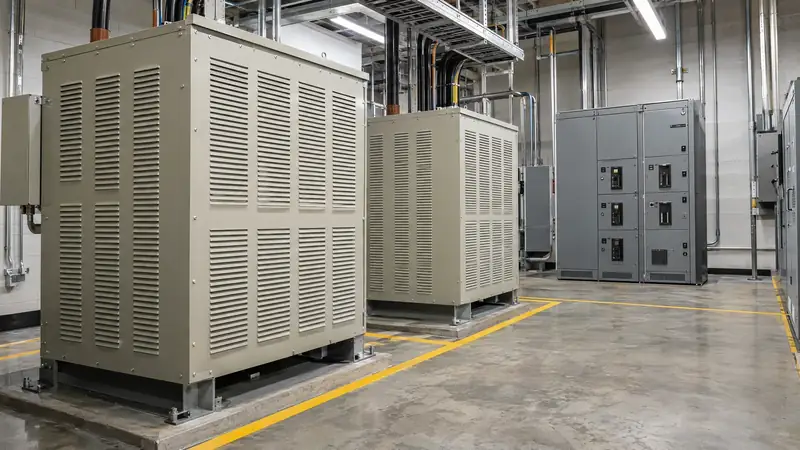
kVACommon Submersible & Vault Sizes We Buy
03Submersible Transformer Sizes, Voltages and Phases
Submersible transformer sizes vary by service and configuration. Single-phase underground units are typically in the tens to hundreds of kVA. Three-phase network and vault equipment commonly falls around 300–2,500 kVA, while custom ratings also exist. Treat these as typical ranges, not a substitute for the actual nameplate.
Primary distribution can fall within 2.4–34.5 kV systems. Secondary ratings may include 120/240 V single-phase, 208Y/120 V network service, 480-class service and other specific configurations. The applicable utility system and the equipment’s actual primary voltage, secondary voltage and connection matter; do not infer a unit’s rating from the city or the surrounding equipment.
For utility and project records, use the stated nameplate values rather than rounding a rating or assuming a voltage from a system description. Our guides to transformer kVA sizes and transformer voltage ratings explain the fields buyers use to compare units.
| Configuration | Typical capacity | Common secondary examples |
|---|---|---|
| Single-phase underground | Tens to hundreds of kVA | 120/240 V |
| Three-phase vault/network | About 300–2,500 kVA | 208Y/120 V |
| Three-phase, other service | Varies; custom sizes exist | 480-class or specific rating |
04Construction Differences That Affect Identification
These units are usually liquid-filled with mineral oil or ester fluid in a sealed, corrosion-resistant tank. Compact dimensions and corrosion-resistant bushings and terminations are important in a vault environment. Construction details differ by manufacturer, voltage, rating and whether the transformer serves a network or non-network installation.
A network model may have an interface for a network protector; that feature does not make every vault transformer a network unit. Similarly, a watertight enclosure rating such as NEMA 4 or 4X does not prove that a transformer is designed for submersion. Ask for equipment documentation when the distinction matters, and share the records with the buyer.
If the unit is actually a different equipment family, the configuration may point to another buyer category. For example, compare it with a pad-mounted transformer or review the broader transformer type guide before describing the equipment.
05What Shapes Resale Interest in a Used Submersible Transformer
Resale interest depends on whether the unit’s ratings and condition suit another application. Buyers consider kVA, phase, primary and secondary voltages, connections, impedance, fluid, winding material if stated, age, and completeness. Standard or useful configurations can be easier to place than unusual ratings, but no single field determines an offer.
For vault equipment, flood exposure, tank sealing or leak-test records, and corrosion at cable terminations and bushings deserve particular attention. A history of immersion does not by itself prove the transformer is unserviceable, but it is important information for evaluating condition. Available factory test reports, oil test or dissolved gas analysis records, insulation resistance and turns-ratio results can also help establish its status.
PCB and fluid records are relevant to the equipment’s handling and potential resale. Do not assume a unit is non-PCB from its age or appearance. California Transformer Buyer reviews available testing and documentation; sellers should rely on records and qualified environmental professionals for determinations and management decisions. This information is not legal advice.
- New-surplus, used, pulled or stored status
- Flood history, leaks, rust and bushing condition
- Test reports and fluid or PCB documentation
- Accessories, missing parts and quantity
- Site access and removal complexity
06What to Send for a Written Offer
To request an offer, provide a clear nameplate photo, overall photos from a safe position, the number of units, the California location and a brief condition description. Include documents that show immersion rating, test results, fluid type, PCB status, ownership, or previous repairs when available. Do not enter an unsafe or restricted area to get a photograph.
Rocky reviews the information and may ask about test reports, fluid records, ownership, site access or other details. California Transformer Buyer buys used, pulled, surplus and new-surplus equipment from California sellers. Reviewing a transformer costs nothing and creates no obligation. Start with the transformer selling process or get an offer from Rocky by form, call or text at (951) 403-5738.
The written offer states the price, what is included, who handles loading or rigging and freight, and payment terms and timing. Confirm the details in writing before pickup. Equipment value depends on the specific unit and transaction conditions; no offer is assumed until the equipment details have been reviewed.
07Plan Removal Through Qualified Electrical and Rigging Personnel
Vault transformers can be difficult to access because they are below grade, heavy, and connected to underground cables. Removal planning may involve the site owner, serving utility, qualified electrical contractor and qualified rigging or hauling personnel. The written offer clarifies who is responsible for loading, rigging and freight before pickup is scheduled.
Sellers should not attempt to de-energize, disconnect, open, drain, sample or move the transformer. Isolation and disconnection must be handled by the owner’s qualified electrical contractor or serving utility. Any work must account for applicable site conditions and potential backfeed from solar, batteries or generators.
If the unit is removed from a constrained vault, provide practical access information and known lifting or transportation limits. See transformer removal and pickup planning for more on coordinating responsibilities.
08Why California Sellers Bring Vault Units to a Buyer
A decommissioned vault transformer, project leftover or spare unit can be a specialized asset rather than ordinary scrap. Sellers contact California Transformer Buyer to have the rating, documentation, condition and logistics reviewed for possible resale. The company buys from California sellers statewide, including single units and larger groups of surplus equipment.
Rocky’s review considers what the equipment is, whether its records support the stated configuration, and what handling the site requires. If you are also comparing other used equipment or deciding how to present a mixed lot, see the used transformer buyer guide.
FAQSubmersible & Vault Transformer FAQ
Does a transformer in a flooded vault count as submersible?
Not automatically. Vault location and flood exposure do not establish that a transformer was designed for immersion. Look for a specific submersible designation, sealing or immersion specification in its nameplate or manufacturer documentation. If the rating is unclear, share the nameplate and available records with the buyer rather than relying on the enclosure appearance or installation history.
Can I sell a vault transformer owned by the serving utility?
Only if you have authority to sell it. Equipment can remain utility-owned even when it is installed on private property or serves a building. Confirm ownership or obtain written authorization before requesting an offer. California Transformer Buyer does not treat a property owner’s possession or access to utility equipment as proof of ownership.
Will you consider a transformer that has been exposed to floodwater?
Flood exposure is important information for review, but it does not by itself establish whether a unit can be resold. Share the extent and known duration of exposure, any inspection or test records, and details of corrosion, leakage or bushing condition. Do not open, drain or test the transformer yourself; use qualified electrical and environmental professionals.
What if the nameplate is damaged or unreadable?
Send safe-position photos of the overall unit and any remaining labels, serial markings or manufacturer information. Available purchase, maintenance, test or utility records may help fill in missing details. A buyer may need to ask follow-up questions, and an offer can depend on whether the equipment’s rating and condition can be established with reasonable confidence.
Can a failed or leaking vault transformer still be reviewed?
You can provide its details for review, but purchase is not guaranteed and a failure or leak can affect the available options. Describe the known fault and provide relevant service, test and fluid records. Do not drain or move the unit. Leaking equipment and its oil may require evaluation by qualified environmental professionals under applicable requirements.
Do you buy several vault transformers as one lot?
California Transformer Buyer considers single units as well as larger groups and mixed lots from California sellers. For multiple transformers, send a separate nameplate photo when possible, along with the quantity, location and condition of each unit. Explain whether the equipment is stored together and note any shared access or removal constraints so the offer can describe the scope clearly.