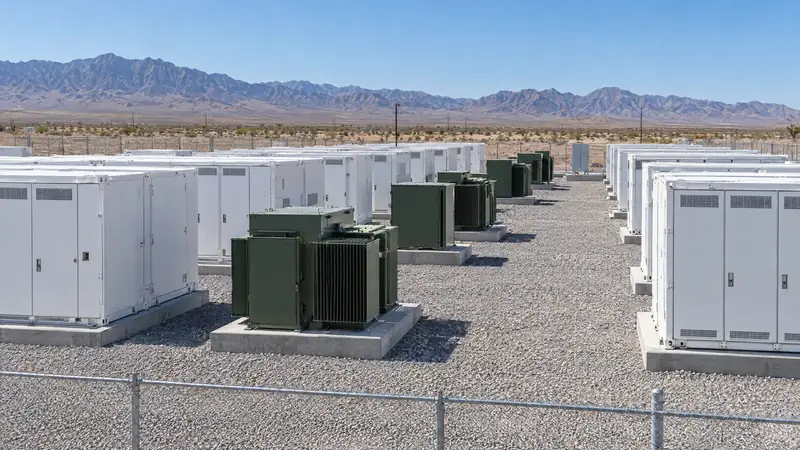
01What a BESS Transformer Does and How to Recognize One
A BESS transformer is the AC transformer between a battery energy-storage system’s power-conversion system (PCS) and the site’s distribution or grid connection. The PCS converts battery DC power to AC for discharge and converts AC back to DC when charging. The transformer couples that equipment to the collector or service voltage and is typically specified for charging and discharging power flow.
Look for project drawings, equipment schedules or a nameplate identifying a battery, energy-storage, PCS or inverter application. The physical unit may be a liquid-filled pad-mounted or substation transformer, or a medium-voltage dry-type or cast-coil unit. Appearance alone cannot confirm its application or duty: nameplate details and project documentation are more useful than a BESS label by itself.
The battery’s DC voltage is not the transformer winding voltage. Check the AC-side winding voltages, kVA ratings for each winding, impedance and connection diagram. A BESS unit may have a multi-winding design or inverter terminal arrangement, so record each winding rather than treating it like a conventional two-winding transformer.
- PCS or inverter duty documentation
- Per-winding kVA and voltage
- Impedance and connection diagram
- Cooling class and insulation type
- Serial number and year of manufacture
02How BESS Transformers Work in California Projects
During discharge, the PCS supplies AC power through the transformer to the site collector or grid connection. During charging, power flows in the opposite direction. This bidirectional duty and the converter’s operating profile can affect thermal performance, so the transformer’s rating and documentation should match the system design rather than relying only on its nominal MVA.
California applications include grid-scale battery facilities, commercial microgrids and renewable-plus-storage sites. Project configurations vary: a transformer may serve an individual PCS block, or a larger station transformer may serve multiple blocks. For context on related equipment, see our pages about California battery storage projects and solar and inverter step-up transformers.
Voltage compatibility is project-specific. The PCS AC side is commonly 480–800 V, depending on the model, while collector or grid-side windings commonly fall in the 12–34.5 kV range. California utility distribution voltages differ by service territory, and the actual transformer nameplate and project interconnection documents take precedence over a general voltage range.
kVACommon Battery Energy Storage (BESS) Sizes We Buy
03BESS Transformer Sizes, Voltages and Configurations
Common ratings span hundreds of kVA through 5,000 kVA per PCS block. Larger blocks can use 7,500–10,000 kVA or more, while central substations can be substantially larger. A common size does not establish interchangeability: winding voltages, phase, impedance, cooling, duty rating and terminal arrangement all need to match the intended application.
Liquid-filled units may use mineral oil or ester fluid in a pad-mounted or substation design. Dry-type and cast-coil medium-voltage designs are also used. Other variations include multi-winding construction, inverter terminal arrangements, and shielding or monitoring features where supplied. Related size references include 1,000 kVA transformers, 2,500 kVA transformers and 5,000 kVA transformers.
| Application scale | Typical rating context | Voltage context |
|---|---|---|
| Individual PCS block | Hundreds of kVA to 5,000 kVA | PCS AC: commonly 480–800 V |
| Large PCS block | 7,500–10,000+ kVA | Verify each winding on nameplate |
| Collector or grid connection | Central substations may be much larger | Commonly 12–34.5 kV |
04What Affects Resale Value for a Used BESS Transformer
Resale value depends on whether the unit can be identified, evaluated and matched to a buyer’s application. Bidirectional duty documentation, per-winding ratings, impedance, cooling class, voltage and connection details help establish fit. A BESS or inverter label alone does not prove suitability for every storage system or establish exemption from efficiency or interconnection requirements.
Condition and records matter. Buyers may review leaks, corrosion, bushing condition, missing accessories, insulation condition, grounding compatibility and load or harmonic-heating information. Factory test reports, oil test or dissolved-gas analysis (DGA) records, insulation-resistance results and turns-ratio tests can help support an evaluation when available.
Other relevant details include age, copper or aluminum windings if identified, fluid type and quantity, PCB documentation, accessories, quantity and removal access. New-surplus equipment that has never been energized differs from used equipment with operating history. Rocky also considers whether the configuration has a likely application; no single nameplate field determines an offer.
- Bidirectional and converter-duty documentation
- Winding ratings, voltage and impedance
- Test reports and maintenance records
- Fluid, PCB and condition records
- Accessories, quantity and site access
05What to Send a BESS Transformer Buyer
To help California Transformer Buyer evaluate a unit, send clear nameplate photos and overall photos taken from a safe position, only where you are authorized to access the equipment. Include quantity, city or site location, condition, and whether the transformer is used or new-surplus. You can text photos to Rocky at (951) 403-5738 or use the transformer offer request page.
If available, include the manufacturer, serial number, year, phase, frequency, kVA for every winding or cooling stage, high- and low-voltage ratings, taps, connection, impedance, BIL and cooling class. Fluid type, gallons, total weight, winding material, PCB label and connection diagram are also useful. Send test reports, ownership information and details about site access when available.
The review may involve follow-up questions about testing, fluid or PCB records, ownership and removal conditions. You must own the transformer or have authority to sell it; equipment owned by a utility cannot be sold by a property owner. Reviewing a transformer costs nothing and creates no obligation.
06Removal Planning for Heavy BESS Equipment
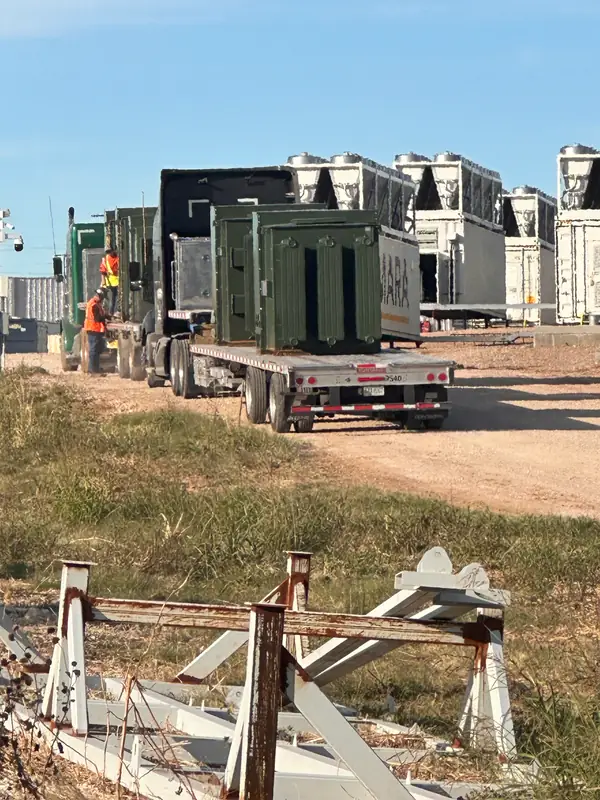
A transformer’s weight, dimensions, access route and surrounding electrical equipment affect removal planning. Large units may require specialized rigging or freight arrangements, and oversize or overweight transport may involve permits. Site conditions can also determine whether accessories or other components affect shipping and handling.
Do not disconnect, open, drain, move or otherwise prepare an energized transformer yourself. The owner’s qualified electrical contractor or serving utility must handle isolation and disconnection; battery, solar and generator backfeed must also be considered. Before pickup, the written offer states what is included, who handles loading or rigging and freight, and the payment terms and timing.
For details on planning a pickup, see transformer removal and pickup. If the equipment is part of a project closeout or spare inventory, our guide to selling surplus transformers after a project may also help.
07Why California Sellers Contact Us About BESS Units
California Transformer Buyer reviews used, pulled, surplus and new-surplus transformers from sellers across California, including single units and project or yard lots. A BESS transformer may be a specialized asset with multiple windings, converter-duty requirements or project-specific voltages, so accurate details help determine whether it fits a resale opportunity.
Rocky reviews the information and, if the unit is a fit, provides a written offer. The written terms state the price, what is included, responsibility for rigging and freight, and payment terms before pickup. To discuss a unit, call or text (951) 403-5738, or use the contact and offer request page.
FAQBattery Energy Storage (BESS) Transformer FAQ
Can I sell a BESS transformer that has been used?
Yes. California Transformer Buyer reviews used transformers from California sellers, along with surplus and new-surplus equipment. A previous operating history does not by itself decide whether a unit is a fit. Share its nameplate, condition, records and location so Rocky can evaluate the specific transformer and its likely resale applications.
Does a BESS transformer have to be labeled for battery storage?
Not necessarily. Some units are identified in project records or equipment schedules as PCS, inverter or energy-storage transformers, while a nameplate may primarily show electrical ratings and construction details. If the application label is missing, provide available drawings and the full winding information. Do not infer bidirectional suitability from appearance alone.
Is a BESS transformer interchangeable with a solar inverter transformer?
Not automatically. Both may connect power-conversion equipment to a medium-voltage collector, but the windings, voltage, impedance, converter duty, cooling and operating profile must suit the project. A solar or inverter label does not establish that a unit is appropriate for battery charging and discharging. Compare the specifications and supporting documentation.
What if the transformer has unknown PCB status?
Provide any existing labels, fluid records, test results and ownership or maintenance documentation. Do not assume a label proves zero PCBs or decide its handling pathway from age alone. PCB status and applicable requirements depend on documentation and, where needed, testing; rely on qualified environmental professionals for determinations. This information is not legal advice.
Can you make an offer from photos alone?
Photos are a useful starting point, especially clear nameplate images and overall views, but they may not answer every question. Rocky may ask for ratings, test reports, fluid or PCB records, quantity, condition, ownership confirmation and site-access details. Provide what you have; missing documentation can be discussed during the review.
Who disconnects the transformer before it is picked up?
The owner’s qualified electrical contractor or the serving utility handles electrical isolation and disconnection. Battery storage and other connected generation can create backfeed considerations, so only qualified personnel should assess the equipment. The seller should not attempt to de-energize, disconnect, open, drain or move the transformer.