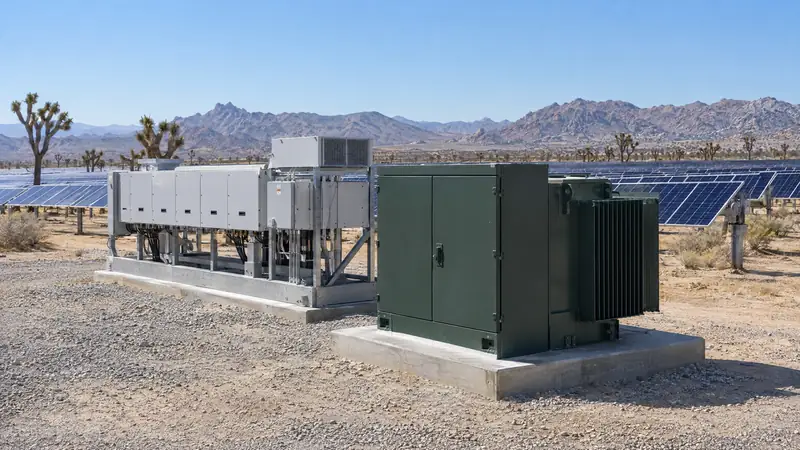
01What a Solar Inverter Step-Up Transformer Does
A solar inverter step-up transformer connects one or more inverters to a medium-voltage AC collector system. The inverter converts photovoltaic system output to AC; the transformer raises that AC voltage for collection and delivery toward the project interconnection. A solar transformer is an application-duty unit, not one fixed voltage ratio or a single standardized construction.
These transformers are used in utility-scale solar farms, commercial renewable projects, and wind collection systems. California projects may use collection voltages from about 12 kV through 34.5 kV, depending on design and interconnection requirements. The actual project specification and transformer nameplate control; PV string or DC bus voltage is not the transformer’s AC voltage rating.
Renewable projects may use equipment alongside battery systems, but the transformer design and duty are not automatically interchangeable. Compare the exact application and electrical requirements when assessing a unit for another project, including related battery storage transformers.
02Visual and Nameplate Clues That Identify a Solar Transformer
A solar inverter transformer may be a pad-mounted, oil-filled unit or a larger skid-mounted assembly. Its enclosure, bushings, cable compartments, radiators, fans, or low-voltage throat can offer clues, but appearance alone does not confirm its duty. Some units have two, three, or four windings to serve multiple inverter inputs.
Look for nameplate details that identify inverter-side and collector-side ratings, winding arrangement, and application. The project drawing or winding diagram can be especially useful when multiple low-voltage inputs are involved. A total kVA rating by itself does not show the capacity available on each inverter winding.
Photos should be taken only from a safe position and only where you are authorized to access the equipment. Do not open compartments or handle the transformer to obtain information; a qualified electrical contractor or serving utility handles equipment access and electrical work.
- Manufacturer, serial number, and year
- kVA rating for each winding or stage
- Primary and secondary voltages and connections
- Impedance, taps, phase, and frequency
- Cooling class, fluid type, and fluid quantity
- Winding diagram and any shielding details
- PCB label or available fluid records
kVACommon Solar & Inverter Step-Up Sizes We Buy
03Solar Transformer Sizes and Voltage Combinations
Common ratings are roughly 500–5,000 kVA per inverter or collector block. Larger block transformers may be rated 7,500–10,000 kVA or more, and some manufacturers offer custom ratings beyond that range. For size references, see typical 1000 kVA transformers, 5000 kVA transformers, and 7500 kVA transformers.
The inverter side commonly uses 480, 600, 690, or 800 V AC, depending on the inverter model and project design. The medium-voltage side commonly falls between 12 and 34.5 kV. Some California renewable collection systems use 34.5 kV, but the nameplate and project documents—not a general rule—determine whether a specific unit fits.
A multi-winding unit may have several distinct low-voltage inverter inputs and a shared medium-voltage output. Each winding’s voltage and kVA, along with the winding-to-winding impedance matrix, matter when evaluating suitability. Solar transformer sizes should therefore be read together with winding configuration, not as a single total number.
04Construction Variations Affect Resale Suitability
Most inverter step-up units are liquid-filled, commonly with mineral oil or natural ester fluid; dry-type renewable designs also exist. Other design details may include two-, three-, or four-winding arrangements, electrostatic shielding, a low-voltage throat, or a tank designed for the project’s pressure-cycling conditions.
Inverter-duty design can account for waveform characteristics, operating cycles, grounding, and impedance requirements. Those features are project-specific. A transformer built for one inverter arrangement may have a narrower group of potential applications than a conventional unit with more common ratings and connections.
When reviewing a renewable unit, include available inverter compatibility information, waveform or duty specifications, grounding details, shield information, and exact winding diagrams. Solar developers and contractors can also review information for solar developers and EPCs when preparing project surplus for sale.
05What Affects the Resale Value of a Used Solar Transformer
A buyer considers more than the total kVA. Rating per winding, voltage combination, phase, impedance, connection, taps, cooling, condition, and whether the unit is used or new-surplus all affect its potential reuse. Commonly needed voltages and complete technical records can make a unit easier to evaluate, while a highly project-specific design may have fewer likely applications.
Condition and documentation also matter. Leaks, corrosion, damaged bushings, missing accessories, or unknown fluid history may affect the assessment. Available factory test reports, oil test or DGA records, insulation resistance results, turns-ratio reports, and PCB documentation help establish what is known about the unit. Environmental status should be assessed using testing, records, and qualified environmental professionals; this information is not legal advice.
Quantity, location, access, and removal complexity are part of the overall review. Brand can help verify specifications, but rating, configuration, condition, records, and resale demand are central considerations. There is no single value that applies to every used solar transformer.
- New-surplus, used, or pulled condition
- Per-winding ratings and configuration
- Voltage, impedance, connection, and taps
- Test, fluid, and PCB documentation
- Accessories, damage, and missing parts
- Quantity, location, and site access
06Information to Send for a Written Offer
California Transformer Buyer reviews transformers located in California, including surplus units left after a cancelled or completed project. To begin, call or text Rocky at (951) 403-5738, send photos by text, or use the contact form. Reviewing a transformer costs nothing and creates no obligation.
Provide clear nameplate photos, overall equipment photos from a safe position, quantity, California location, and a brief description of known condition. Mention whether the unit is new-surplus, used, or removed, and include any test reports, fluid or PCB records, ownership information, and details about site access. A complete package helps avoid confusion about multi-winding capacity.
Rocky may ask follow-up questions before preparing a written offer. The offer states the price, what is included, who handles loading or rigging and freight, and payment terms and timing. Those responsibilities and terms are provided in writing before pickup. For guidance on project leftovers, see selling surplus after a project.
07Removal Planning for Pad-Mounted and Skid Units
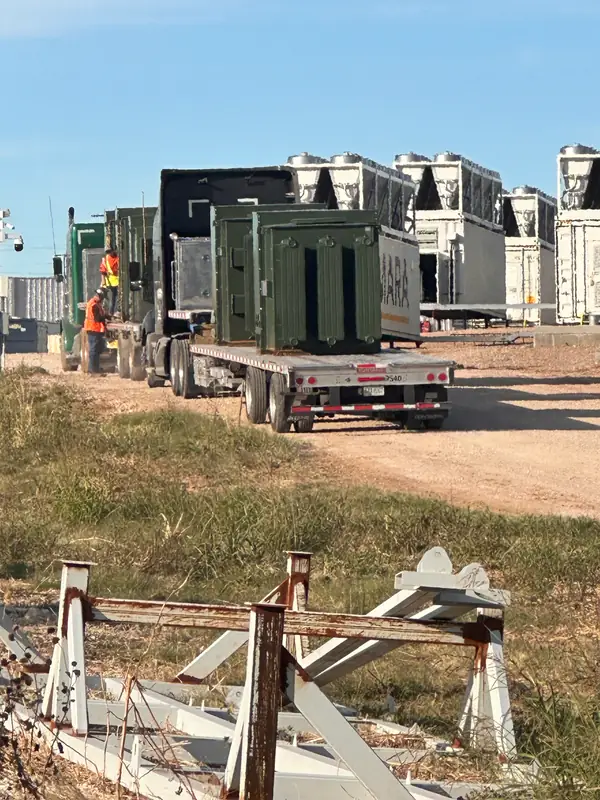
Solar step-up transformers are heavy electrical equipment, and their connections may be part of an operating generation system. The owner’s qualified electrical contractor or serving utility is responsible for required isolation and disconnection. Solar, battery, or generator backfeed must be considered by qualified personnel; sellers should not attempt electrical work or move the unit themselves.
Before agreeing to a pickup, share site access information and any known lifting, loading, or transport constraints. The written offer identifies who handles rigging and freight, so the parties can confirm responsibilities before removal is scheduled. Equipment condition and configuration can affect the work required.
For more detail about responsibilities and planning, review transformer removal and pickup. Do not open compartments, drain fluid, or take samples for the sale inquiry; rely on records and qualified professionals for testing or environmental questions.
08Why California Sellers Contact a Solar Transformer Buyer
A cancelled project, design change, completed installation, or inventory reduction can leave a specialized transformer without a planned use. California Transformer Buyer considers used, surplus, and new-surplus equipment from sellers across California. Rocky reviews the actual configuration and available records rather than assuming all solar transformers are alike.
A direct equipment review can help a seller understand whether a unit merits an offer before arranging a disposition. California Transformer Buyer also evaluates other project surplus; learn more about the surplus transformer buying process. Send the equipment details through the contact form to request an offer, or call or text (951) 403-5738.
FAQSolar & Inverter Step-Up Transformer FAQ
Can I sell a solar transformer if the project was cancelled?
Yes, California Transformer Buyer reviews project surplus from cancelled or completed projects when the equipment is located in California. Share the quantity, location, condition, nameplate photos, and any available project or test records. The unit must belong to you or you must have authority to sell it. A property owner cannot sell equipment owned by a utility.
Do you consider new-surplus solar transformers that were never energized?
Yes. New-surplus transformers that have never been energized may be considered, whether crated, on skids, or otherwise stored. Include photos of the unit and packaging, nameplate information, storage condition, and any factory test reports. Mention whether accessories and documents are included so the offer can identify exactly what is being considered.
Is the total MVA rating enough to identify a multi-winding transformer?
No. The total rating may not describe the usable capacity of each inverter winding. Provide the nameplate’s individual winding ratings, voltage combinations, connection or vector diagram, and impedance information if available. Inverter compatibility and project duty details can also help show whether the unit may suit another application.
Can you make an offer without testing the transformer?
Send the information you have, including nameplate and overall photos, condition notes, and any existing test reports. Rocky may ask for additional records or clarification during review. Do not arrange unsafe access or perform electrical work to create new information. Testing and electrical assessment should be handled by qualified professionals.
What if I do not know the PCB or fluid status?
Tell us that the status is unknown and send any available labels, maintenance records, or prior test documents. Do not drain the transformer or take a sample yourself. PCB status and fluid management can depend on testing and qualifying documentation, so rely on qualified environmental professionals for determinations and applicable handling guidance.
Can a transformer be removed while the solar plant is operating?
Electrical isolation and disconnection must be coordinated by the owner’s qualified electrical contractor or serving utility, not by the seller or buyer acting without that coordination. Generation, battery, and other sources can create backfeed hazards. Pickup timing and responsibilities are confirmed in writing, but safe electrical clearance remains the responsibility of qualified personnel.